Antahkarana
is a way, a conduit, a connection between our intelligent mind and the
higher levels of perception and consciousness. Antahkarana is a Sanskrit
word for "Rainbow Bridge", the pathway that the Seeker must trailblaze
in order to be released from Samsara.
The weaving of this individual connection is the way to reach a higher
conscience of Shambhala. Antahkarana is also known as an ancient symbol
of Spiritual Healing.
Biblical Reference: Jacob's Ladder Jacob's Ladder
is a ladder to heaven, described in the Book of Genesis that the
biblical patriarch Jacob envisions during his flight from his brother
Esau. Jacob dreamed that there was a ladder set up on the earth, and the
top of it reached to heaven; and behold, the angels of God were
ascending and descending on it! And behold, the Lord stood above it [or
"beside him"] and said, "I am the Lord, the God of Abraham your father
and the God of Isaac; the land on which you lie I will give to you and
to your descendants; and your descendants shall be like the dust of the
earth, and you shall spread abroad to the west and to the east and to
the north and to the south; and by you and your descendants shall all
the families of the earth bless themselves. "
Apocalyptic Literature
The narrative of the Jacob's Ladder was used, shortly after the
Destruction of the Temple, as basis for a pseudepigraphic text of the
Hebrew Bible: the Ladder of Jacob. This writing, a non-rabbinic Jewish
text preserved only by Christians, interprets the experience of
Patriarchs in the context of Merkabah mysticism.
In the Gospel
of John 1:51 there is clear reference to Jacob's dream (Genesis 28:12)
and it points towards Jesus Christ who is called with his title of Son
of Man: "And he said to him, "Truly, truly, I say to you, you will see
heaven opened, and the angels of God ascending and descending on the Son
of Man." The theme of the ladder to heaven is often used by the
Early Church Fathers: Saint Irenaeus in the 2nd century describes the
Christian Church as the ladder of ascent to God.
In
the 3rd century Origen explains that two are the ladders in the
Christian life: the first, the ascetic ladder that the soul climbs on
the earth increasing the virtues; and second, the travel that the soul
does after the death, climbing the heavens up to the light of God.
In the 4th century Saint Gregory of Nazianzus speaks of ascending
Jacob's Ladder by successive steps towards excellence, interpreting thus
the ladder as an ascetic path, while Saint Gregory of Nyssa narrates
that Moses climbed on Jacob's Ladder to reach the heavens where he
entered the tabernacle not made with hands, thus giving to the Ladder a
clear mystical meaning. The ascetic interpretation is found also in
Saint John Chrysostom who writes: "And so mounting as it were by steps,
let us get to heaven by a Jacob's ladder. For the ladder seems to me to
signify in a riddle by that vision the gradual ascent by means of
virtue, by which it is possible for us to ascend from earth to heaven,
not using material steps, but improvement and correction of manners."
Antahkarana Antahkarana
is the main conduit that builds the relationship between the three
different levels of consciousness: The Shambhala Consciousness, the
Higher Human Consciousness and the Hierarchy Consciousness. The
Consciousness of Shambhala is related to the original Monad and the
aspects of the Will. The Hierarchy Consciousness is related to the Soul
and the Love aspect. The Human Consciousness relates to the
Personality and the Intelligence aspect.
Antahkarana is a cord
developed by the Seeker through Meditation & directed Spiritual
practice. It requires fortitude and perseverance to reach a progress on
this path. There are much old residues, negative activated memory cells
and psychic rubbish that need to be cleared of one's energy field in
order to nurture the new openings for the relationship with our souls.
In the first Stage of development, the Seeker receives direct help from
the Soul, and later from the Monad. The Seeker must manifest the
correct Intention and will to reweave the connection, once that this new
bond will be built upon the Original Cord linked by the Soul to the
Lower Bodies, namely Sutrama.
Sutrama is the Thread of Life,
sometimes called "the Silver Cord" and it makes the connections into the
lower three worlds, and Lower Bodies. It is an independent energy
stream which stretches from God, which travels through an infinity of
chakra levels though the fabric of dimensions (time/space) until it
eventually reaches the grounding point in our Pineal Gland. This is
truly our Spiritual link to higher consciousness.
Antahkarana
is a vehicle of Wisdom and Clarity of Purpose on our daily lives.
Antahkarana is a thread of Spiritual Light and it is built just the same
way as a spider weaves its web. Its string of light is weaved by the
Seeker life after life, and can only be 'energized" by higher Spiritual
vibrations. Antahkarana can only be built with the Mental and high
Spiritual qualities of one's Soul. The construction of the Rainbow
Bridge can be very slow. It requires constant practice and experience
on the energetic field. Its final construction turns the Mental
Consciousness receptive to the direction from the Soul and later enables
it to receive the directives from the Monad Itself.
The
spiritual union between the higher guidance alchemizes the Personality
to be a reliable resource for the Soul on its Purpose on Earth. It is
important during the process of developing the personal Antahkarana, to
also develop the "Earth Thread", which is the extension of the upper
connection of the soul with the Core of earth.
The
relationship between the Antahkarana and the Earth Core is very
important, because through it, we help and support the building of the
Planetary Antahkarana, and consequently build the deeper relationship
with "All That Is".
Antahkarana is a necessary tool for the activation of Merkabah, astral and time traveling, and Stargate passing.
Abstract
The innumerable recorded and researched cases of past life
experiences clearly point to life after death. In all the recorded cases
of reincarnations, it was found that there was a variable time lag
between the death of the person and his next reincarnation on Earth. So,
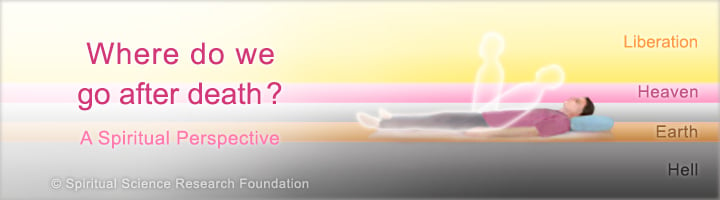
where do we go after death till our reincarnation on Earth? Is it a
single plane of existence or are there a variety of planes of existence?
If so, what are the factors that decide where we go after death? In
this article, we present the answers to these and other questions about
this topic. These answers are obtained through spiritual research done by seekers of the Spiritual Science Research Foundation (SSRF) with highly developed sixth sense (ESP).
Note: In order to understand this article better, it is recommended
that you read the article on the three subtle basic components of Sattva, Raja and Tama.
1. What happens after death?
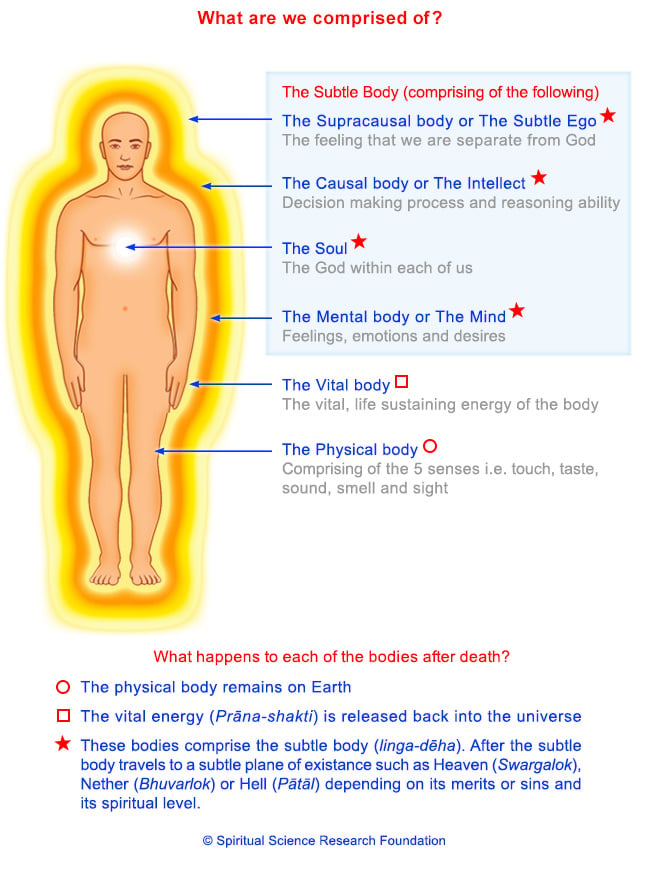
Spiritual research has shown that man is comprised of the following four basic bodies:
Physical
Mental
Causal or intellectual
Supracausal or subtle ego
The picture below is a diagrammatic representation of what a human being is comprised of.
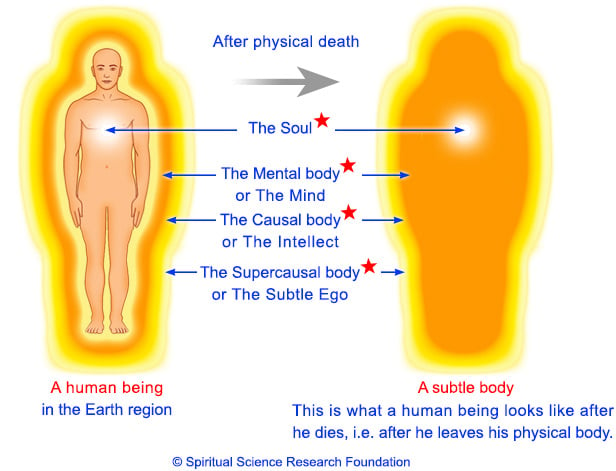
When a person dies the physical body ceases to exist. However, the
rest of his existence or consciousness continues. The existence of the
person minus the physical body is known as the subtle body (linga-dēha)
and it comprises of the mental, causal (intellect) and supracausal
(subtle ego) bodies. This subtle body then goes to one of the 13 subtle
planes of existence other than the Earth plane.
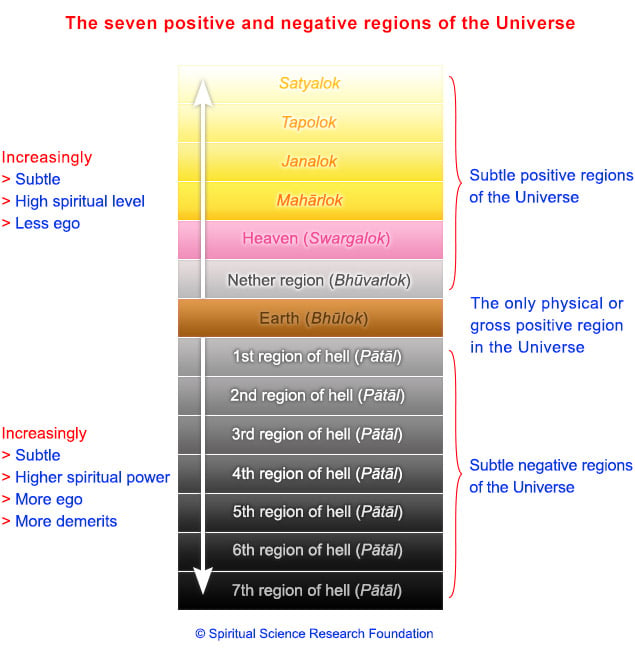
2. The 14 planes of existence in the Universe
There are 14 main planes of existence in the Universe. Seven of them
are positive planes of existence and seven are negative planes of
existence. The seven negative planes of existence are commonly known as
Hell (Pātāl). There are numerous sub-planes within these main planes of existence.
Righteousness (Dharma) is that which accomplishes the 3 tasks of:
Keeping the social system in excellent condition
Bringing about the worldly progress of every living being
Causing progress in the spiritual realm as well.
– Shri Adi Shankaracharya
Seven positive planes of existence: The planes of
existence occupied mostly by living persons and subtle bodies doing
righteous deeds and engaged in spiritual practice according to the
positive path of spiritual practice are known as the seven positive
planes of existence or saptalok. By positive path, we mean the
orientation of spiritual practice is towards God-realisation, which is
the ultimate in spiritual growth.
The Earth plane is the only physical plane of existence in the
Universe and is also the first plane of existence in the hierarchy of
the positive planes of existence in the Universe.
Seven Negative planes of existence: These are planes
of existence occupied mostly by subtle bodies that have done
unrighteous deeds and are engaged in spiritual practice according to the
negative path. By negative path, we mean the orientation of spiritual
practice is towards attaining spiritual power, e.g. supernatural powers.
This spiritual power is primarily used to enhance one’s control over
others or for negative purposes. Thus all subtle bodies that go to any
one of the planes of existence of Hell, by virtue of their evil
intentions become ghosts.
Sub planes of existence of Hell (Narak): Every plane of existence of Hell has a sub-plane known as Narak. For example, the first plane of existence of Hell will have within it a sub-plane that is known as the first Narak. Narak is reserved for the worst ghosts (demons, devils, negative energies, etc.) in Hell. The ghosts (demons, devils, negative energies, etc.) occupying the first Narak face more severe punishment and for a longer duration than those occupying the first plane of existence of Hell.
The diagram below shows the 14 planes of existence in the Universe.
Please note:
1. For the sake of simplicity, though we have shown the planes of
existence one on top of the other in this diagram, in reality they are
around us in all directions. It’s just that Earth being the physically
tangible plane is seen; whereas the other planes are progressively more
and more subtle and hence invisible to the gross eye. In fact different
people, though living on the Earth plane experience thoughts and
emotions corresponding to the different planes of existence as per their
spiritual level or thoughts. For example Saints, i.e. spiritually
evolved people beyond the 70% spiritual level, lead an existence
corresponding to the positive planes of existence of Heaven and beyond.
In contrast a person planning theft experiences thoughts corresponding
to the 1st plane of Hell, one planning some act aimed at harming others
at 2nd plane of Hell and so on and a person planning murder experiences
thoughts corresponding to the 7th plane of Hell. However no 2 planes of
existence can be experienced simultaneously, i.e. a person cannot
experience thoughts corresponding to 2 different planes, e.g. Heaven and
Mahārlok.
2. The Nether region (Bhuvarlok) to be precise is a region
that is aligned away from God. We have however depicted it as a positive
plane as subtle bodies from this region still have a chance to be born
on Earth to progress spiritually.
Once subtle bodies regress to any of the regions of Hell, then there is a
remote possibility of their being born on Earth and progressing towards
God. An explanation behind the colour scheme used
Earth is depicted reddish as it represents action (i.e. subtle basic Raja component), as it is the only plane where we have the physical body to do something.
Heaven has been depicted in pink, which represents an abundance of happiness.
Yellow represents spiritual knowledge and an increase in the subtle basic Sattva
component. It finally becomes almost white at the highest stage, which
represents the close proximity to the unmanifest God principle.
The regions of Hell are represented by darker shades to black, as there is an increase in the subtle basic Tama component.
3. Heaven and the other positive planes of existence in the Universe
Plane of existence1
Spiritual Level %
Proportion of Sattva component
Type of person
Predominant body6
Predominant emotion
Satya
90
95
Nearly completely knowledgeable
Subtle ego /Supracausal
Sattvik happiness (5%)
Bliss & Serenity (95%)
Tapo
80
90
Highly knowledgeable
Intellect/Causal
Sattvik happiness (25%)
Bliss & Serenity (75%)
Jana
70
85
More knowledgeable
Intellect/Causal
Sattvik happiness (50%)
Bliss & Serenity (50%)
Mahar
605
80
Knowledgeable
Intellect/Causal
Sattvik happiness9(75%)
Bliss & Serenity (25%)10
Superior Heaven
50
75
More Merits
Intellect/Causal
More happiness
Inferior Heaven
404
60
Fewer Merits
Mental body
Less happiness8
Nether
(Bhuvarlok)2
25
40
Average
Desires part of the mental body
Unhappiness7
Earth
203
33
Average
Physical
Happiness/Unhappiness
Footnotes (based on the numbers in red in the above table):
Each positive and negative plane of
existence beyond the Earth (physical) plane of existence becomes more
and more subtle. By subtle, we mean, that which is beyond the
comprehension of the five senses, mind and intellect. Satyalok
is the subtlest positive plane, and therefore is the most difficult to
perceive or comprehend unless the highest sixth sense (ESP) level is
attained.
Due to lack of spiritual practice and a
higher proportion of demerits (sins), most people in the current era go
to either the Nether world or one of the planes of existence of Hell.
We generally go to the Nether world after death when the proportion of
demerits (incurred due to wrong doings on Earth) is approximately 30%.
Demerits typically include malice towards others and a lot of desires.
The likelihood of being attacked in the Nether world by higher-level
ghosts from the lower plane of existence of Hell is almost certain.
Earth is the only plane of existence
where there is an amalgamation of people with varying spiritual levels.
However, after death we go to the precise plane of existence
corresponding to our spiritual level.
The minimum spiritual level required to attain Heaven after death is 40%. Please refer to the article, which describes what spiritual level is and the breakdown of the world population in 2016 according to spiritual level.
Basically from the Spiritual science perspective, meritorious acts to
attain Heaven or the higher positive planes of existence are those acts
done without expectation with the objective of God-realisation. The
following three criteria can be applied:
Acts done without doership, i.e., with the outlook that God Himself
is getting it done from me and hence I cannot lay claim to any credit.
Done without expectation of acclaim or appreciation.
Done without expectation of results. More than the acts per se, it is the attitude or outlook behind the acts that counts more.
It is important to note that subtle bodies at the borderline of just
40% and thereabouts often get pulled back by negative energies and hence
remain in the Nether world (Bhuvarlok).
To attain a higher plane of existence
that is beyond Heaven, one needs to be at a spiritual level higher than
60%. This can only be achieved by consistent spiritual practice according to the six basic laws of spiritual practice along with a major reduction in ego.
By predominant body, we mean the body
that is most active, i.e., mental, intellect or the subtle ego. For
example, in the Nether plane of existence (Bhuvarlok), the
subtle bodies still have a lot of desires and attachments. As a result,
quite often they become ghosts trying to fulfil some desire of theirs
through their descendants or people on Earth. This leaves them open to
higher-level negative energies from the lower regions of Hell; who take
advantage of their cravings so as to affect people on Earth.
In the Nether world plane of existence, subtle bodies experience only unhappiness as desires cannot be fulfilled.
In the plane of existence known as
Heaven, subtle bodies experience an overabundance of happiness. This
happiness is much beyond the happiness experienced on Earth in quantity,
quality and duration. As we go up the positive planes of existence,
there is an increase in the quality of happiness and no unhappiness.
Sāttvik happiness means
happiness derived from helping others without any expectations or
strings attached. When ego is involved in the act, it becomes rājasik.
Serenity is a higher spiritual experience than Bliss.
3.1 Positive planes of existence and reincarnation on Earth
From the subtle planes of existence below Maharlok,
people need to be reincarnated on the Earth plane of existence in order
to settle their destiny and complete their give-and-take accounts. If
after one’s death one attains higher regions such as Maharlok or Janalok
due to higher spiritual level, one does not need to be reincarnated as
all of the individual’s remaining destiny (accumulated account) can be
worked out from these planes themselves. However, these evolved subtle
bodies may choose to be born of their own will. They do so because of
their expansive nature primarily to act as spiritual guides for humanity
and to help society grow spiritually.
In some circumstances people who pass away even below the spiritual level of 60% can attain Maharlok.
Here the person’s potential for further spiritual growth is considered.
Through spiritual research we have found that that there are 5 factors
that influence this potential for further spiritual growth.
Having a high amount of spiritual emotion (bhāv),
Having a low ego,
Having an intense desire for spiritual growth,
Doing regular spiritual practice of increasingly higher levels,
Affected or not affected by negative
energies. Being affected/possessed by negative energies can severely
obstruct the ability for spiritual growth. In the afterlife such
affected subtle bodies even if they are at a spiritual level of 60% can
be obstructed from reaching the higher subtle regions of the Universe by
negative energies.
3.2 The importance of the Earth plane of existence
The Earth plane of existence is very important. It is the only plane
of existence where we can make rapid spiritual growth and settle our
give-and-take account in the shortest period of time. The main reason
for this is that with the help of the physical body, we can do many
things to enhance our spiritual growth and spiritual level and reduce
the basic subtle Tama component.
Other than Earth, spiritual growth is mostly likely to occur only in the regions beyond Heaven such as Maharlok etc.
This is because in Heaven, the subtle bodies run the risk of getting
caught up in the unending pleasures it offers. In the Nether and Hell
planes of existence, the punishment is so severe and also the distress
from the other higher-level ghosts is such that it becomes very
difficult to rise above the suffering to undertake any spiritual
practice of value.
4. What is Hell, who goes to Hell and what is Hell like?
As one goes to lower planes of existence of Hell, as the subtle basic Sattva component progressively reduces the environment becomes less conducive to the experience of happiness.
Within the planes of existence of Hell, there are some ghosts
who do certain types of spiritual practice to gain spiritual power. The
highest in the hierarchy of ghosts are sorcerers from the seventh plane
of existence of Hell. They have immense spiritual power almost
equivalent to a Saint at the 90% spiritual level. They control all the other types of ghosts with lesser spiritual power.
As one goes deeper into the various planes of existence of Hell,
i.e. from 1st to 7th, the extent of happiness experienced by the subtle
bodies therein goes on decreasing and the extent of unhappiness goes on
multiplying. The minimal experience of happiness is also due to being
engrossed in memories of past positive events, pleasant memories of
wealth in a past life, etc. The experience of unhappiness is due to
memories of physical pain and insulting events, memories of unfulfilled
desires, e.g. regarding education, house, career, expectation of
happiness from children in past life.
The extent of punishment/pain to be endured in the various planes of existence of Hell and their associated Narak goes on increasing with the subsequent plane of existence of Hell. Also, the period of punishment to be endured in each Narak
is in excess compared to the corresponding plane of existence of Hell.
If we consider the punishment in first plane of existence of Hell as
100%, then the punishment in the corresponding first Narak region is 50% more, i.e. 150%.
The following table is a description of examples along with the
average intensity of happiness and unhappiness we experience in the
various planes of existence of Hell.
5. Movement between subtle planes of existence in the Universe
One is assigned that plane of existence which matches one’s basic nature in terms of Sattva, Raja and Tama.
This is also a function of one’s spiritual level. Hence, subtle bodies
from lower positive planes of existence cannot go to higher positive
planes of existence and those from first or second negative planes of
existence cannot go to the deeper planes of existence Hell. This is
similar to how people living in the planes find breathing difficult at
higher altitudes, but people staying at higher altitudes manage fine.
6. What decides where we go after death?
At the time of death, as the physical body becomes inactive the vital
energy used for the functioning of the physical body is liberated into
the Universe. This vital energy at the time of death propels the subtle
body away from the Earth region. Just as the weight of a projectile
decides how far a rocket will propel it, similarly the weight of the
subtle body decides which plane of existence it goes to in the subtle
planes of existence in life after death.
The ‘weight’ of the subtle body is primarily a function of the amount of the subtle basic Tama component in our being.
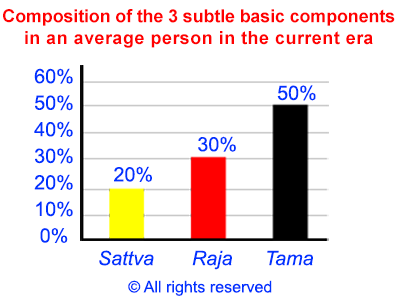
The 3 subtle basic components: Each one of us is made up of three subtle basic components or guṇas. These components are spiritual in nature and cannot be seen but they define our personalities. They are:
Sattva: Purity and knowledge
Raja: Action and passion
Tama: Ignorance and inertia In an average person in the current era, the basic subtle Tama component is as high as 50%.
Please read the article on the 3 subtle basic components
The more we are filled with the Raja and Tama
components the more we display the following characteristics which add
to our ‘weight’ and impact which plane of existence we go to in our life
after death:
More attachment to worldly things and selfishness
More unfulfilled desires
Feelings of revenge
Higher amount of demerits or wrong-doings
Higher amount of personality defects such as anger, greed, fear, etc.
A higher amount of ego: By ego we mean how much a person identifies
himself with his body, mind and intellect as opposed to the soul within
Resulting in lower spiritual level
A permanent reduction in the proportion of the subtle basic Tama
component and the related characteristics mentioned above come about
only with sustained spiritual practice according to the six basic laws
of spiritual practice. Psychological improvements with self-help books
or trying to be nice are at best superficial and temporary.
6.1 Importance of the mental state at the time of death
The mental state at the point of death, apart from what has been
mentioned above, is very important. Our mental state is generally
relative to the proportion of the subtle basic components in our being.
If a person is actually doing his spiritual practice such as chanting the Name of God
at the time of death then the influence of desires, attachments,
ghosts, etc. are minimal possible for that person compared to his state
when not chanting. This makes his subtle body lighter. Hence, if he
passes away while chanting, he attains better plane of existence among
the sub-planes than what he would have attained were he to pass away
without chanting.
At the time of death, if a person is chanting the Name of God and is
also in a state of surrender to God’s will, then he attains an even
better plane of existence in his life after death and his sojourn is
undertaken with lightening speed. This is because the person being in a
state of surrender on Earth plane of existence itself, has very less
chance of increasing his ego in his life after death. Also, the entire
responsibility of his well-being in his life after death is undertaken
by his evolved spiritual guide (Guru).
6.2 Who goes to Hell?
The following are the types of deeds in our life on Earth that typically land us in one of the planes of existence of Hell.
The extent, duration and intention behind the wrong-doings are
important factors deciding the planes of existence of Hell attained
after death rather than just the action itself.
7. Suicide and the after life
There are two types of death with regards to its timing. Destined final death: This is the time of death that no one can escape. Possible death: This is where a person can possibly
die. Each person may undergo a possible death wherein one comes close to
death but may be saved due to his or her merits.
For more information on the types of death please refer to our article – Time of Death
In cases where a person is going through insurmountable crisis in his
life or has severe personality disorders, he may think of taking his
own life in a depressed state. Ghosts (demons, devils, negative energies, etc.)
also fuel the depression of a suicidal person and sometimes are
instrumental in pushing a person over the edge into committing suicide.
However, in most cases, suicide remains a wilful act that happens when a
person is going through a possible death phase as per their destiny.
Life on the Earth plane of existence is precious and is given to us
primarily for spiritual growth. When we kill others, we create/settle a
karmic give-and-take account with them. However by committing suicide,
we squander away the opportunity for spiritual growth and hence incur
demerits or sin. The gravity of sin can vary depending on the
circumstances under which a person commits suicide. Invariably the
subtle-body of an average suicide case will go to Bhuvarlok.
However for greater sins incurred during their life and the
circumstances under which they commit suicide they can go to the lower
regions of Hell.
Killing a Saint incurs the maximum amount of sin and on a scale of 0-100, it is 100.
Killing an ordinary person incurs 40 on the same scale
Killing oneself incurs 30% sin as opposed to killing another person
of average spiritual level. Generally people who commit suicide are at a
lower spiritual level. Their spiritual level gets eroded due to
continuous depression.
Cause
Sin incurred
Merits
Comments
Where only oneself is involved
Physical: If one is experiencing severe pain or terminally ill due
to illness and cannot take the pain any more voluntary euthanasia.
30% of killing another person of average spiritual level
–
Refer to the article on Euthanasia – Section 4.2
Psychological: Severe depression, psychiatric patient
30% of killing another person of average spiritual level
–
Spiritual: Taking one’s life when totally under the command of negative energies
0
–
The subtle body-continues to be under the influence of negative
energies after death. Intense spiritual practice helps to come out of
the clutches of demonic possession.
Where others are involved
Sacrificing oneself to save others selflessly
0
Varies
Depends on who one is sacrificing for. If sacrificing oneself for an
evil person then one in fact incurs demerits and not merits.
Sacrificing oneself to save a Saint’s life
0
100
Saving a Saint’s life accrues the highest amount of merits.
Suicide bomber (killing oneself and others)
Varies
Varies
As per cause.
For example if a soldier were to kill Hitler in a suicide mission to
save millions of lives and rid the world of a menace, then merits would
be accrued.
Alternatively if a suicide bomber killed innocent adults and children then only demerits would be incurred.
8. Why is there a time lag between two reincarnations?
In the course of research by using hypnotic trance to trace the past
lives of the person, it has been found that the time lag between two
reincarnations on Earth could be on average 50 to 400 years. The reasons
for this time lag are as follows:
The subtle body remains in the Heaven or the Nether plane of
existence for variable periods of time to undergo its merits and
demerits (sins).
Circumstances on Earth plane of existence need to be favourable to
complete the give-and-take account from previous births with various
people. This is in accordance with the law of Karma. The
reincarnation of the subtle body is postponed until the time various
other people who they have a give-and-take account with are also
preparing to take reincarnation.
Sometimes in past life regression, a person does not report a
reincarnation in the trance state. The reason for this is that a certain
reincarnation has been very uneventful or brief and the person may not
remember any details of it.
In the case of subtle bodies that have been relegated to the deeper
planes of existence of Hell, the time lag between two reincarnations may
be thousands of years. They stay in their respective plane of existence
of Hell until such time they have completed their punishment. In most
cases, this means languishing in plane of existence of Hell in their
life after death till the dissolution of the Universe.
9. Life after death – in summary
The above facts about the various planes of existence give us a fair
idea of the possible consequences in our life after death of how we live
our lives. Only with spiritual practice or with extreme meritorious
deeds can one go to the higher planes of existence and thereby avoid
unhappiness and punishment and enjoy higher levels of happiness. There
are also better chances of a reincarnation on Earth plane of existence
in circumstances conducive to spiritual practice. This is so that one
moves further up in the subtle planes of existence in the Universe. As
we go further into the current Era of Strife (Kaliyug), there is lesser likelihood of people going to the higher planes of existence.
Once we go to the lower planes of existence such as the Nether plane
of existence or other planes of existence of Hell, we stay there and
experience severe unhappiness for centuries until we completely pay for
our demerits (sins) by suffering the intense punishments meted there and
get a chance to be reincarnated on Earth.
To do consistent spiritual practice on the Earth plane of existence
according to the 6 basic laws of spiritual practice is like swimming
against the tide in the current era. However, it is also a guaranteed
way of advancing to higher planes of existence in our life after death.
Merkabah, also spelled Merkaba, is the divine light vehicle allegedly
used by ascended masters to connect with and reach those in tune with
the higher realms. "Mer" means Light. "Ka" means Spirit. "Ba" means
Body. Mer-Ka-Ba means the spirit/body surrounded by counter-rotating
fields of light, (wheels within wheels), spirals of energy as in DNA,
which transports spirit/body from one dimension to another.
The Merkabah is a UFO
Chariot of the Gods (See below)
Flower of Life
The Flower of Life
is a geometrical figure composed of multiple evenly-spaced, overlapping
circles, that are arranged so that they form a flower-like pattern with
a six-fold symmetry like a hexagon. In other words, the center of each
circle is on the circumference of six surrounding circles of the same
diameter. The Temple of Osiris at Abydos, Egypt contains the oldest to
date example. it is carved in granite and may possibly represent the Eye
of Ra a symbol of the authority of the pharaoh.
Other examples can be found in Phoenician, Assyrian, Indian, Asian,
Middle Eastern, and medieval art. A Flower of Life pattern can be
constructed with a pen, compass and paper, by creating multiple series
of interlinking circles. In some renditions, the rosette on the
unofficial flag of Padania is a partial version of the flower of life
pattern. The Flower of Life pattern contains the basis of Metatron's Cube. From this pattern, all five of the Platonic solids can be derived.
Mer-Ka-Ba Meditation
In modern esoteric teachings, it is taught that the MerKaBa is an
interdimensional vehicle consisting of two equally sized, interlocked
tetrahedra of light with a common center, where one tetrahedron points
up and the other down. This point symmetric form is called a stella
octangula or stellated octahedron which can also be obtained by
extending the faces of a regular octahedron until they intersect again.
In his books, researcher and physicist Drunvalo Melchizedek
describes this figure as a "Star Tetrahedron", since it can be viewed
as a three dimensional Star of David. By imagining two superimposed
"Star Tetrahedrons" as counterrotating, along with specific "prana"
breathing techniques, certain eye movements and mudras, it is taught
that one can activate a non-visible 'saucer' shaped energy field around
the human body that is anchored at the base of the spine.
Depending on the height of the person doing the exercise, this field is
about 55 feet across. Once activated, this 'saucer' shaped field is
capable of carrying ones consciousness directly to higher dimensions.
The Teaching Of Spherical Breathing: Using 18 Breaths
By Drunvalo Melchizedek
There are 17+1 breaths, where the first six are for balancing the
polarity, the next seven for proper pranic flow through the entire body.
The further breaths are for shifting the consciousness from 3rd to 4th
dimension and finally the last three breaths is for re-creating the
rotating Merkabah within and around the body. The last breath is not
taught. Once each day, enter into this meditation, until the time comes
when you are a conscious breather, remembering with each breath your
intimate connection with God.
FIRST BREATH: Inhale
HEART: Open your heart and feel love for all life. If you cannot do this, you must at least open to this love
as much as is possible for you. This is the most important instruction of all.
MIND: Become aware of the male tetrahedron (the apex facing up to the sun, the point facing to the front
for male, the point to the back for females) filled with the brilliant white light surrounding your body.
Visualize it the best you can. If you cannot visualize it, sense or feel it surrounding you.
BODY: At the same moment of inhalation, place your hands in the mudra of your thumb and first finger
touching. Remember, lightly touch your fingers, and do not allow your fingers to touch each other or any
other object. Keep your palms facing up.
BREATH: At this same moment, with empty lungs, begin to breath in a complete yogic manner. Breath
through your nostrils only, except at certain places which will be described. Simply put, breath from your
stomach first, then your diaphragm, and finally your chest. Do this in one movement, not three parts. The
exhale is completed either by holding the chest firm and relaxing the stomach, slowly releasing the air, or
by holding the stomach firm and relaxing the chest. The most important aspect is that this breathing must
be rhythmic. Begin by using seven seconds in and seven seconds out, but as you get familiar with this
meditation, find your own rhythm. The following instructions for a complete Yogic Breath are from "the
Hindu-Yogi Science of Breath" by Yogi Ramacharake. Perhaps this description will be helpful.
Breathing through the nostrils, inhale steadily, first filling the lower part of the lungs, which is accomplished
by bringing into play the diaphragm, which descending exerts a gentle pressure on the abdominal organs,
pushing forward the front walls of the abdomen. Then fill the middle part of the lungs, pushing out the lower
ribs, breastbone and chest. Then fill the higher portion of the lungs, protruding the upper chest, thus lifting
the chest, including the upper six or even pairs of ribs.
At first reading it may appear that this breath
consists of three distinct movements. This, however, is not the correct idea. The inhalation is continuous,
the entire chest cavity from the lowered diaphragm to the highest point of the chest in the region of the
collar bone, being expanded with a uniform movement. Avoid a jerky series of inhalations, and strive to
attain a steady continuous action. Practice will soon overcome the tendency to divide the inhalation into
three movements, and will result in a uniform continuous breath. You will be able to complete the inhalation
in a few seconds after a little practice.
Exhale quite slowly, holding the chest in a firm position, and drawing the abdomen in a little and lifting it
upward as the air leaves the lungs. When the air is entirely exhaled, relax the chest and abdomen. A little
practice will render this part of the exercise easy, and the movement once acquired will be afterward
performed almost automatically.
FIRST BREATH: Exhale
HEART: Love
MIND: Become aware of the female tetrahedron, (apex pointing to the earth, point facing to the back for
males, point facing to the front for females), also filled with the brilliant white light
BODY: Keep the same mudra.
BREATH: Do NOT hesitate at the top of the inhalation to begin the exhalation. Exhale quite slowly,
approximately seven seconds, in the Yogic manner. When the air is out of the lungs, without forcing, relax
the chest and abdomen and HOLD the breath. When you feel pressure to breathe again, after about five
seconds or so, then do the following:
MIND: Be aware of the flat equilateral triangle at the top of the female tetrahedron located in the
horizontal plane that passes through your chest at the sternum. In a flash, and with a pulse like energy,
send that triangular plane down through the female tetrahedron. It gets smaller as it goes down and pushes
out the tip or apex of the tetrahedron all the negative energy of the mudra or electrical circuit, a light will
shoot out of the apex toward the center of the Earth. The Mind exercise is performed along with the
following BODY movements.
BODY: Move your eyes slightly toward each other, or, in other words, slightly cross your eyes. Now bring
them up to the top of their sockets, or in other words, look up. Also, this looking up motion should not be
extreme. You will feel a tingling feeling between your eyes in the area of your third eye . You can now look
down to the lowest point you can, as fast as you can. You should feel an electrical sensation move down
your spine. The MIND and BODY must coordinate the above mental exercis e with the eye movements. The
eyes look down from their up position at the same time the mind sees the triangular horizontal plane of the
female tetrahedron move down to the apex of the female tetrahedron. This combined exercise will clean
out the negative thoughts and feelings that have entered into your electrical system. Specifically, it will
clean out the part of your electrical system that is associated with the particular mudra you are using.
Immediately upon pulsing the energy down your spine, you change mudras to the next one and begin the
entire cycle over again. The next five breaths are a repeat of the first breath with the following mudra
changes:
Second breath mudra: Thumb and second finger together
Third breath mudra: Thumb and third finger together
Fourth breath mudra: Thumb and little finger together
Fifth breath mudra: Thumb and first finger together (same as first breath)
Sixth breath mudra: Thumb and second finger together (same as second breath)
The first part, the first six breaths, the balancing of the polarities, and the cleansing of your electrical
system is now complete. You are now ready for the next part, the next seven breaths.
Here an entirely new breathing pattern begins. You do not need to visualize the star tetrahedron at this
time. Only the tube that runs through the star, from the apex of the male tetrahedron above your head to
the apex of the female tetrahedron below your feet, needs to be seen and worked with. This extends one
hand length above your head and one hand length below your feet. The diameter of YOUR tube will be the
size of the hole formed by YOUR thumb and forefinger touching.
BREATH NUMBER SEVEN: Inhale
HEART: Love. There is another refinement here that can be used after you have perfected this meditation.
MIND: Visualize or sense the tube running through your body. The instant you begin the seventh inhale,
see the brilliant white light of the prana moving down the tube from the top and up the tube from the
bottom at the same time. This movement is almost instantaneous. The point where these two light beams
meet within your body is controlled by the mind and is a vast science known throughout the universe. In
this teaching however, we will only be shown what is necessary , that which will take you from third to
fourth dimensional awareness. In this case you will direct the two beams of prana to meet at your navel, or
more correct, within your body at navel level, inside the tube. The moment the two beams of prana meet,
which is just as the inhale begins, a sphere of white light or prana is formed at the meeting point about the
size of a grapefruit centered on the tube. It all happens in an instant. As you continue to take the inhale of
the seventh breath, the sphere of prana begins to concentrate and grow slowly.
BODY: For the next seven breaths use the same mudra for both inhale and exhale, the thumb, first and
second touching together palms up.
BREATH: Deep rhythmic Yogic breathing, seven seconds in and seven seconds out. There is no holding of
the breath from now on. The flow of prana from the two poles will not stop or change in any way when you
go from inhale to exhale. It will be a continuous flow that will not stop for a long as you breath in this
manner, even after death.
SEVENTH BREATH: Exhale
MIND: The prana sphere centered at the navel continues to grow. By the time of the full exhale, the prana
sphere will be approximately eight or nine inches in diameter.
BREATH: Do not force the air out of your lungs. When your lungs are empty naturally, immediately begin the
next breath.
EIGHTH BREATH: Inhale
HEART: Love.
MIND: The prana sphere continues to concentrate life force energy and grow in size
EIGHT BREATH: Exhale
MIND: The prana sphere continues to grow in size and will reach maximum size at the end of this breath.
This maximum size is different for each person. If you put your longest finger in the center of your navel,
the line on your wrist defining your hand will show you the radius of the maximum size of this sphere for
YOU. This sphere of prana cannot grow larger.
NINTH BREATH: Inhale
MIND: The prana sphere cannot grow larger, so what happens is the prana begins to concentrate within
the sphere. The visual appearance is that the sphere grows BRIGHTER.
BREATH: Sphere grows brighter and brighter as you inhale.
NINTH BREATH: Exhale
BREATH: As you exhale, the sphere continues to grow brighter and brighter.
TENTH BREATH: Inhale
MIND: About half way through this inhale, as the sphere continues to brighter, the prana sphere reaches
critical mass. The sphere ignites into a sun, a brilliant blinding ball of white light. You are now ready for the
next step.
TENTH BREATH: Exhale
MIND: At the moment of exhale, the small sphere two hand lengths in diameter bulges to expand. In one
second, combined with the breath talked about below, the sphere expands quickly out to the sphere of
Leonardo, out at your finger tips of your extended arms. Your body is now completely enclosed within a
huge sphere of brilliant white light. You have returned to the ancient form of spherical breathing. However,
at this point, this sphere is not stable. You MUST breath three more times to keep the sphere stable.
BREATH: At the moment of exhale, make a small hole with your lips and blow out your air with pressure. As
you feel the sphere begin to bulge, all within the first second of this exhale, let all of your air out rapidly.
The sphere will expand at that moment.
ELEVENTH, TWELFTH and THIRTEENTH BREATH: Inhale and Exhale
MIND: Relax and just feel the flow of the prana flowing from the two poles and meeting at the navel and
then expanding out to the large sphere
BREATH: Breath rhythmically and deeply. At the end of the thirteenth breath you have stabilized the large
sphere and are ready for the important 14th breath.
THE FOURTEENTH BREATH
HEART: Love
MIND: On the inhale of the 14th breath, at the very beginning of the breath, move the point where the two
beams of prana meet from the navel to the sternum, the fourth dimensional chakra. The entire large sphere,
along with the original sphere, which is also still contained within the large sphere, moves up to the new
meeting point within the tube. Though this is very easy to do, it is an extremely powerful movement.
Breathing from this new point within the tube will inevitably change your awareness from third to fourth
dimensional consciousness, or from earth consciousness to Christ consciousness.
BODY: This mudra will be used for the rest of the meditation. Place the left palm on top of the right palm
for males and the right palm on top of the left palm for females. It is a mudra that relaxes.
BREATH: Rhythmic breath and deep. However, if you continue to breathe from your Christ center without
moving on to the MER-KA-BA, which is what is recommended until you have made contact with your Higher
Self, then shift to a shallow breath. In other words, breath rhythmically but in a comfortable manner where
your attention is more on the flow of energy moving up and down the tube meeting at the sternum and
expanding out to the large sphere. Just feel the flow. Use your feminine side to just be. At this point don't
think, just breath, feel and be. Feel your connection to All Life through the Christ Breath. Remember your
intimate connection with God.
The Mer-Ka-Ba, The Vehicle Of Ascension
The Last Three Breaths
You are asked not to attempt this FOURTH PART until you have made contact with your Higher Self, AND
your Higher Self has given you permission to proceed. This part is to be taken seriously. The energies that
will come into and around your body and spirit are of tremendous power. If you are not ready, you could
hurt yourself. If your Higher Self gives you permission to enter into the MER-KA-BA, then don t fear, for
you will be ready.
FIFTEENTH BREATH: Inhale:
HEART: Love
MIND: Be aware of the whole star tetrahedron. Realize that there are three whole star tetrahedrons
superimposed over each other. One is the body itself, and is locked in place and never, except under
certain conditions, moves. It is placed around the body according to maleness or femaleness. The second
whole star tetrahedron is male in nature, it is electrical, is literally the human mind and rotates
counter-clockwise relative to your body looking out, or to put it another way, it rotates toward your left
side. The third whole star tetrahedron is female in nature, is magnetic, is literally the human emotional body
and rotates clockwise relative to your body looking out, or to put it another way, it rotates toward your
right side.
To be clear, we are not telling you to rotate the male tetrahedron one way and the female the other way.
When we say rotate the whole star tetrahedron, we mean the whole thing.
On the inhale of the fifteenth breath, as you are inhaling, you will say to yourself, in your head, the code
words, EQUAL SPEED. This will tell your mind that you want the two rotatable whole star tetrahedrons to
begin spinning in opposite directions at equal speeds at the time of the exhale. Meaning that for every
complete rotation of the mind tetrahedrons, there will be a complete rotation of the emotional
tetrahedrons.
BODY: Continue the mudra of the folded hands from now on.
BREATH: Breath Yogic and rhythmically an deeply again, but only for the next three breaths, after that
return to the shallow breathing.
FIFTEENTH BREATH: Exhale
MIND: The two sets of tetrahedrons take off spinning. In an instant, they will be moving at exactly one third
the speed of light at their outer tips. You probably will not be able to see this because of their tremendous
speed, but you can feel it. What you have just done is to start the MOTOR of the MER-KA-BA. You will not
go anywhere, or have an experience. It is just like starting the motor of a car, but having the transmission
in neutral.
BREATH: Make a small hole with your lips just like you did for breath Number Ten. Blow out in the same
manner, and as you do, feel the two sets of tetrahedrons take off spinning.
SIXTEENTH BREATH: Inhale
MIND: As you let out the breathe, the two sets of tetrahedrons take off from their one third speed of light
setting to two third speed of light in an instant. As they approach two thirds speed of light speed a
phenomena takes place. A disk about 55 feet in diameter forms around the body at the level of the base of
the spine. And the sphere of energy that is centered around the two sets of tetrahedrons forms with the
disk to create a shape that looks like a FLYING SAUCER around the body. This energy matrix is called the
MER-KA-BA. However, it is not stable. If you see or sense the MER-KA-BA around you at this point, you
will know it to be unstable. It will be slowly wobbling. Therefore Breath Number Seventeen is necessary.
BREATH: Same as breath 16, make a small hole in your lips, and blow out with pressure. It is at this point
that the speeds increases. As you feel the speed increasing, let out all your breath with force. This action
will cause the higher speed to be fully obtained and the MER-KA-BA to be formed.
SEVENTEENTH BREATH: Inhale
HEART: Remember, unconditional love for all life must be felt through out all of this meditation or no results
will be realized.
MIND: As you breathe in, say to yourself, in your head, the code NINE TENTHS THE SPEED OF LIGHT. This
code will tell your mind to increase the speed of the MER-KA-BA to nine tenths the speed of light which will
stabilize the rotating field of energy. It will also do something else. This third dimensional universe that we
live in is tuned to 9/10 the speed of light. Every electron in your body is rotating around every atom in
your body at 9/10 the speed of light. This is the reason this particular speed is selected.
BREATH: Breathe rhythmically and in a Yogic manner.
SEVENTEENTH BREATH: Exhale
MIND: The speed increases to 9/10 the speed of light and stabilizes the MER-KA-BA.
BREATH: Same as breath 15 and 16, make a small hole in your lips, and blow out with pressure. As you feel
the speed take off, let all your breath out with force. You are now in your stable and Third dimensionally
tuned MER-KA-BA. With the help of your Higher Self, you will understand what this really means.
EIGHTEENTH BREATH:
This very special breath will not be taught here. You must receive it
from Your Higher Self. It is the breath that will take you through the
speed of light into the fourth dimension. You will disappear from this
world and reappear in another one that will be your new home for awhile.
This is not the end, but the beginning of an ever expanding
consciousness returning you HOME to your FATHER.
Merkaba
The word Merkaba or Merkava - Hebrew 'Chariot' or 'to ride an animal, in
a chariot' - is used in the Bible (Ezekiel 1:4-26) to refer to the
throne-chariot of God, the four-wheeled vehicle driven by four Cherubim,
each of which has four wings and four faces (of a man, lion, ox, and
eagle). Four means 'time' in alchemy.
In medieval Judaism, the beginning of the book of Ezekiel was regarded
as the most mystical passage in the Bible, and its study was
discouraged, except by mature individuals with an extensive grounding in
the study of traditional Jewish texts.
Jewish biblical commentaries emphasize that the imagery of the Merkaba
is not meant to be taken literally; rather the chariot and its
accompanying angels are analogies for the various ways that God reveals
Himself in this world.
Maimonides in his 13 principles of faith emphazies that God is not limited to any particular form, as this prophesy might seem to imply.
Chassidic philosophy and Kaballah explain at length what each aspect of
this vision represents in this world, and how they in no way imply that
God is made up of these forms. The danger of understanding these
passages as literal descriptions of God's image likely accounts for the
opposition among Torah scholars towards learning this topic without the
proper initiation. Jews customarily read the Biblical passages
concerning the Merkaba in their synagogues every year on the holiday of
Shavuot.
History
The earliest merkabah speculations were exegetical expositions of the
prophetic visions of God in the heavens, and the divine retinue of
angels, hosts, and heavenly creatures surrounding God. The earliest
evidence suggests that merkabah homiletics did not give rise to ascent
experiences - as one rabbinic sage states: "Many have expounded upon the
merkabah without ever seeing it" (Tosefta' Megillah 3[4]:28).
The Talmudic interdictions concerning merkabah speculation are numerous
and widely held. Discussions concerning the merkabah were limited to
only the most worthy sages, and admonitory legends are preserved about
the dangers of overzealous speculation concerning the merkabah. The
sages Rabbi Yochanan Ben Zakkai (d. ca. 80 CE) and later, Rabbi Akiva
(d. 135) were deeply involved in merkabah speculation. Rabbi Akiva and
his contemporary Rabbi Ishmael ben Elisha are most often the
protagonists of later merkabah ascent literature.
Beyond the rabbinic community, Jewish apocalyptists also engaged in
visionary speculations concerning the divine realm and the divine
creatures which are remarkably similar to the rabbinic material. A small
number of texts unearthed at Qumran indicate that the Dead Sea
community also engaged in merkabah speculation. Recently uncovered
Jewish mystical texts also evidence a deep affinity with the rabbinic
merkabah homilies. Recently, considerable scholarly attention has been
paid to the use of merkabah themes in early Jewish-Christian circles.
The merkabah homilies eventually consisted of detailed descriptions of
multiple layered heavens (usually seven in number), often guarded over
by angels, and encircled by flames and lightning. The highest heaven
contains seven palaces (hekhalot), and in the innermost palace resides a
supreme divine image (God's Glory or an angelic image) seated on a
throne, surrounded by awesome hosts who sing God's praise.
When these images were combined with an actual mystical experiential
motif of individual ascent (paradoxically called "descent" in most
texts) and union is not precisely known. By inference, contemporary
historians of Jewish mysticism usually date this development to the
third century CE. Again, there is a significant dispute amongst
historians over whether these ascent and unitive themes were the result
of some "foreign," usually Gnostic, influence, or a natural progression
of religious dynamics within rabbinic Judaism.
The Biblical Merkaba in Depth
According to the verses in Ezekiel and its attendant commentaries, the
analogy of the Merkaba image consists of a chariot made of many angels
being driven by the "Likeness of a Man." Four angels form the basic
structure of the chariot. These angels are called the "Chayot".
The bodies of the "Chayot" are like that of a human being, but each of
them had four faces, corresponding to the four directions the chariot
can go (north, east south and west). The faces are that of a man, a
lion, an ox (later changed to a child or cherub) and an eagle. Since
there are four angels and each has four faces, there are a total of 16
faces. Each Chayot angel also has four wings.
Two of these wings spread across the length of the chariot and connected with the wings of the angel on the other side.
This created a sort of 'box' of wings that formed the perimeter of the
chariot. With the remaining two wings, each angel covered its own body.
Below, but not attached to the feet of the "Chayot" angels are other
angels that are shaped like wheels. These wheel angels, which are
described as "a wheel inside of a wheel", are called "Ophannim" -
wheels, cycles or ways).
These wheels are not directly under the chariot, but are nearby and
along its perimeter much like the wheels of a car. The angel with the
face of the man is always on the east side and looks up at the "Likeness
of a Man" that drives the chariot. The "Likeness of a Man" sits on a
throne made of saphire.
The Bible later makes mention of a third type of angel found in the
Merkaba called "Seraphim" (lit. burning) angels. These angels appear
like flashes of fire continuously ascending and decending.
These "Seraphim" angels functioned somewhat like pistons in that they
powered the movement of the chariot. In the hierarchy of these angels,
"Seraphim" are the highest, that is, closest to God, followed by the
"Chayot", which are followed by the "Ophannim".
The chariot is in a constant state of motion, and the energy behind this
movement runs according to this heirarchy. The movement of the "Ofanim"
is controlled by the "Chayot" while the movement of the "Chayot" is
controlled by the "Serafim". The movement of all the angels of the
chariot are controlled by the "Likeness of a Man" on the Throne.
A Chassidic Explanation
Chassidic philosophy explains that Merkaba is a multi-layered analogy
that offers insight into the nature of man, the ecosystem, the world,
and teaches us how to become better people.
The four Chayot angels represent the basic archetypes that God used to
create the current nature of the world. Ofannim, which means ways, are
the ways these archetypes combine to create actual entities that exist
in the world. For instance, in the basic elements of the world, the lion
represents fire, the ox earth, the eagle wind, and the man water.
However, in practice, everything in the world is some combination of all
four, and the particular combination of each element that exist in each
thing are its particular Ofannim or ways. In another example, the four
Chayot represent spring, summer, winter and fall. These four types of
weather are the archetypal forms. The Ofannim would be the combination
of weather that exists on a particular day, which may be a winter-like
day within the summer or a summer like day within the winter or
whatever.
The Man on the throne represents God, who is controlling everything that
goes on in the world, and how all of the archetypes He set up should
interact.
The Man on the throne, however, can only drive when the four angels connect their wings.
This means that God will not be revealed to us by us looking at all four
elements (for instance) as separate and independent entities. However,
when one looks at the way that earth, wind, fire and water (for
instance) which all oppose each other are able to work together and
coexist in complete harmony in the world, this shows that there is
really a higher power (God) telling these elements how to act.
This very lesson carries over to explain how the four basic groups of
animals and the four basic archetypal philosophies and personalities
reveal a higher, godly source when one is able to read between the lines
and see how these opposing forces can and do interact in harmony. A
person should strive to be like a Merkaba, that is to say, he should
realize all the different qualities, talents and inclinations he has
(his angels).
They may seem to contradict, but when one directs his life to a higher
goal such as doing God's will (the man on the chair driving the chariot)
he will see how they all can work together and even complement
eachother.
Ultimately, we should strive to realize how all of the forces in the
world, though they may seem to conflict can unite when one knows how to
use them all to fulfill a higher purpose, namely to serve God.
Key Texts
The ascent texts are extant in four principal works, all redacted well
after the third but certainly before the ninth century CE.
They are: 1) Hekhalot Zutartey ("The Lesser Palaces"), which details an
ascent of Rabbi Akiva; 2) Hekhalot Rabbati ("The Greater Palaces"),
which details an ascent of Rabbi Ishmael; 3) Ma`aseh Merkabah ("Account
of the Chariot"), a collection of hymns recited by the "descenders" and
heard during their ascent; and 4) Sepher Hekhalot ("Book of Palaces,"
also known as 3 Enoch), which recounts an ascent and divine
transformation of the biblical figure Enoch into the archanel Metatron,
as related by Rabbi Ishmael.
A fifth work provides a detailed description of the Creator as seen by the "descenders" at the climax of their ascent.
This work, preserved in various forms, is called Shi`ur Qomah
("Measurement of the Body"), and is rooted in a mystical exegesis of the
Song of Songs, a book reputedly venerated by Rabbi Akiva.
The literal message of the work was repulsive to those who maintained
God's incorporeality; Maimonides (d. 1204) wrote that the book should be
erased and all mention of its existence deleted.While throughout the
era of merkabah mysticism the problem of creation was not of paramount
importance, the treatise Sefer Yetzirah ("Book of Creation") represents
an attempt at cosmogony from within a merkabah milieu.
This text was probably composed during the seventh century CE, and
evidences influence of Neoplatonism, Pythagoreanism, and Stoicism.
It features a linguistic theory of creation in which God creates the
universe by combining the 22 letters of the Hebrew alphabet, along with
emanations represented by the ten numerals, or sefirot.
Merkabah Wikipedia
Spirituality is a huge topic of discussion lately as more and more
people are awakening to a higher sense of truth and curiosity about the
nature of the universe. Often, we hear people discussing the “Expansion of Consciousness”... But what exactly does that mean?
Typically,
whomever is speaking this aphorism is telling you to raise your
awareness, because through awareness of great truths, one finds freedom
in the understanding. It does not mean to change yourself or alter who
you are, but rather to realize that you are not your body or mind, but
the observer, and we all have a lot to learn.
Here are some ways that you can do this, to become more free, and less constrained by issues that come up in life.
Trust Your Inner Voice
That little voice inside your head is actually a big deal: your
subconscious mind. So if it tells you to take a different path to work
or school today, listen! You never know what you’ll come across. Chances
are it’s something your subconscious feels that your conscious mind
can’t attune to.
Rise Above The Bicameral Mind
The ‘Bicameral mind‘ is a concept coined by psychologist Julian Jaynes, presented in his book The Origin of Consciousness in the Breakdown of the Bicameral Mind. Essentially, the idea is that one part of the brain speaks, and another part listens (and obeys).
Jaynes theorizes that the breakdown of bicameralism is ongoing, and
leads to introspection and consciousness. In the next stage of
evolution, we will overcome this duality.
Travel
If
travel is impractical or not affordable, the study of other cultures
through the internet, documentaries, books and periodicals can serve as a
replacement (however, there is no substitute to immersing one’s self in another area of the world). Compare the standards of other cultures to your own.
What does it mean to be beautiful and successful to the other
culture? What are the differences in their cultural history lessons?
Knowing these is important, as it makes one realize that perceived
objectivity and standardization is easily demolished.
Listen To Binaural Beats
These are simply sounds tuned to a certain frequency that can shift
your brain waves to a meditative state easily. There is information on
YouTube on this subject, and they are easy to find and free to use.
Check What’s Important To You In Life
If you search your life and find that you’ve assigned significant
meaning to material things, such as your car, home, hair, clothes, or
other possessions, try to revise how you think about them. These can
often be a substitute for actually reflecting upon the self, as we can
easily link our personality to our things.
Be Intentional
Good results take on a whole new meaning if the intentions were not
good. At times we can find ourselves doing good while at the same time
backslapping ourselves for doing good things, or doing them for
recognition. Have positive intentions to be assured that what you are
doing is within your truth.
Be Humble
We
are all human: fragile with an endpoint. When we are honest with one
another about our essential humanity, we can find common ground and love
for people. If you are hurting, don’t be afraid to share. If you find
that confessions are hard, they are likely the things you need to share
the most.
Growing As A Person Is An End In Itself
We don’t want to become better people with the intention of making
more money, being more successful, or impressing that person you think
would be an ideal partner. In addition, personal growth is not about
becoming more happy, pleasing god or because it’s the right thing to do.
All of these examples are how we change into the person we think we
should be, rather than simply accepting who you are and how you will
change over time naturally.
Feel
Feelings are to be appreciated, because they offer an opportunity to
be immersed within an experience. Be conscious and present with your
feelings, and be totally within the moment of experience.
Let Love Guide You
Remember
that if you catch yourself being jealous or having a feeling of
superiority, that is coming from the ego. The Soul, however, acts from a
point of love. Being aware of your core being and where your thoughts
come from is the first step in becoming more conscious.
The
concept of a new year can bring promise and sometimes a sense of not
being content with what we have. Our mind is naturally inclined toward
the negative and as a result we may focus on what needs to be fixed or
what isn’t going well in our lives. We can bring an energy of
discontentment into the New Year and with it a feeling of pressure. Have
you ever heard yourself think, “This is the year that I have
to…exercise more, meet the man/woman of my dreams, land that dream job,
etc.”
The New Year is an opportunity to grow and develop new qualities that
will more closely align with the kind of person we want to be and the
life we want to be living. But first, it’s important to acknowledge
everything that we already have and bring into the New Year with us. If
we forget this important step, we are setting too lofty of expectations
for our year because we are coming from a sense of lack vs. a feeling of
“I have enough.”
“Changing is like being in a ship on the sea. You must
build a new boat with material from the old one you’re traveling in. You
can’t go on shore to destroy the old one first and then build a new
one, but you have to reconstruct while sailing.”
—Otto Neurath
As we move into 2016, I encourage the following steps to cultivate a contented New Year.
1. Acknowledge all the qualities you possess, your relationships,
and experiences from the last year you are bringing with you into the
New Year
When the New Year arrives, you don’t become a NEW you. You are the
same person, but you have an opportunity for change and growth. You are
bringing your compassion and your resiliency. You may bring your inner
critic, your wisdom of the mind, body, and heart, and even your
resistance to change. Make a list of what you are bringing with you.
2. Reflect on what you are grateful for
I notice for myself that when I dream of living a different life than
what I am living, wanting something else, someone else, striving for
something that isn’t right here, I suffer and I am not content with what
I have. I take a lot of comfort in knowing how the simple act of
bringing gratitude to the moment I am in shifts my mind from a sense of
lack to contentment. If I can be happy now, under these circumstances
and conditions (which are always changing and different than I sometimes
wish them to be) then I can be happy anywhere, at any time. Allow
yourself to feel the abundance in your life and then see how this
impacts your hopes and wishes for the New Year.
I feel grateful for:
my health
my professional opportunities
my friends and family
living in a place where I can access nature easily
my meditation practice
3. Cultivate an intention vs. a goal
In the New Year, we often set very specific goals
with a short timeline. This creates a feeling of striving for the
unachievable and instead of succeeding, we fail. Meaningful change
happens on a continuum over time.
An intention is something we build and cultivate over time. It grows
by watering it with attention, patience, and wise effort. A goal tends
to have a specific result and is time oriented.
Goal Example: I must find the love of my life in the next two months.
Intention Example: My intention is to cultivate more
love in my life. I know that by aligning my actions with this
intention, I will be more loving and will attract more love in my life.
4. Share your intention with friends, family, and your greater community
When we share what we want in life and are witnessed in this, we have
more power to manifest our greater potential. Here are some intentions I
have heard this year.
I want to cultivate more compassion toward myself and others.
I want to become more generous.
I want to develop more patience.
I want to feel more proud of the person I am.
I want to feel more comfortable with uncertainty.
5. Identify what actions are in alignment with this intention
Using the example above, if I am committed to bringing love into my life I will:
Spend time nourishing my mind, body, and heart so that I can love all parts of myself.
I will choose love over fear and dare to trust.
I give the benefit of the doubt to other person and trust in their goodness.
I will be more open to new people, no matter how they appear in my life.
I will share with those around me, my intention for love in my life.
6. Be 100% committed to your intention for change
With repeated effort and staying true to your intention you will
create what you seek. Be open to the surprise of how and when it occurs.
7. Review your progress over the year
I have been setting intentions for my life for several years and I
find that checking in on my progress 3 times a year is really helpful.
Identify a time when you will reflect on your progress with kindness and
acceptance. Compassion vs. criticism is the greatest motivator toward change.
8. Let go so that you can bring in the new
In order to grow something new in your life you must make space for
it. For example, if you are cultivating more patience then you must
start to let go of impatience. By letting go of a certain way of being
or a pattern in your life, you can manifest something different.
What do you want to let go of in 2015?
What do you want to bring in?
May your New Year be full of light, love, and peace. If you want to
cultivate greater mindfulness and well-being, sign up for the free Mindful Training workbook.
Carley Hauck works as an educator, life
coach, writer, mindful researcher, and change cheerleader with corporate
organizations. Carley has had a long-standing meditation practice and
teaches mindfulness as the first step toward well-being. She teaches on
a variety of subjects related to greater happiness, health, and wisdom
in worksites such as Pixar & LinkedIn and with her students at
Stanford University.
Inside Out revolves around the life of an 11-year old girl
named Riley, who is moving across the country with her family. At such
an impressionable age, a move is a huge transition, and she experiences
an outpour of emotions as she leaves her home, friends, and hockey
league behind. Enter the main characters, Riley’s feelings: Joy,
Sadness, Anger, Fear, and Disgust, who provide a glimpse into the
workings of Riley’s mind as she navigates this life-changing experience.
From the moment it started, I couldn’t contain my excitement. The
nerd in me was blown away by the extraordinary way in which many of the
movie’s messages “measured up” to reality from a neuro-scientific
perspective. For example, the way a day full of short-term/working
memories is then consolidated during sleep.
While the film gave up some scientific integrity for the sake of
storytelling, its poetic license didn’t drive too far away from the
reality that we are, essentially, made up of personality traits that wax
and wane during different points in our life.
Beyond the intricate science of it all, what Inside Out did do
so well was to provide the empowering message that we should learn how
to understand, connect to, and accept our feelings and memories in a way
that is conducive to thriving.
Five ways Inside Out taught us about the importance of emotions:
1. All of our emotions exist for a purpose
Emotions are neither inherently good or bad, and to think of them in
such dichotomous terms is to do yourself a disservice. Every emotion
tells us something about our inner experience that might be informing
our outer experience.
In fact, Rumi, the Sufi poet, waxed poetic in “The Guest House” a
long time ago about how we should treat every emotion as a visitor,
without looking to get rid of any of them, and instead work to
understand their message and purpose.
What Rumi alluded to in his writing was also recently confirmed by
research that indicates that well-being is actually predicated on having
a wider range of emotions. The more you can feel—in all of feeling’s
iterations—the better off you are.
2. To have emotions is to have a compass
At one point in the film, Joy tries to keep Sadness away from Riley.
Although she felt other emotions, the inability to feel sadness, coupled
with her mother’s request for Riley to stay happy, ultimately lead to a
cold and numb existence. This state only generated poor judgment and
unhealthy choices. It wasn’t until she felt sadness that Riley was able
to see more clearly and reach out for support. Acknowledging and
understanding emotions is much healthier, productive, and adaptive than
ignoring their importance.
3. Our realities and memories are filtered through our emotional lens
Just like our present reality is seen through the framework of our
past experience, the memories we look back on are colored by our
present-moment experience. In Riley’s case, she recalled a championship
hockey game several different times during the movie. At one point, she
remembers missing the winning shot and feeling sad about it. At another
point, she literally remembers the same moment, but this time, she
recalls smiling as she is championed by her teammates who pick her up
onto their shoulders to let her know how valuable she is to the team.
Same memory, the only difference being that it was recalled through a
sad lens, and then through a joyful lens.
This is a very powerful idea. What we really “need” to remember is
that our memories are a part of our personal narrative, and that in many
ways, we construct the narrative we believe. Because we create the
narrative, we can change our story at any time. We can’t delete certain
paragraphs that contain with negative facts and daunting realities. We
can’t cut out chapters that we would rather not have had—they will
always be there, and that’s okay. Research suggests that the actual
experiences we have are less impactful than the story we tell ourselves
about them.
4. Having the language to talk about emotions is empowering
Probably the most remarkable part of the movie is its existence as a
film that focuses on emotions. As long as more than a modicum of
scientific integrity exists, what’s important is that an illustration of
the concept of emotion can now impact the dialogue we have with our
children.
If children learn earlier on to embrace the way they feel, and that
it’s crucial to feel all of their emotions, we can hope to see more
adjusted adolescents and adults. Really, though, animation aside, this
movie’s target audience is feasibly all of humanity. Why? Because to
have the language to talk about our emotions, in all of their
iterations, is to be empowered with an ability to learn from them, to
respond to them with the utmost of compassion, and approach them with
less judgment.
5. Feeling our emotions is a universal human experience
Pixar knew what it was doing when it used 5 scientifically validated
universal emotions, stemming from Dr. Paul Eckman’s work (the 6th
universal emotion is surprise). Through Eckman’s research, he showed
that certain emotions are felt and expressed through universal facial
expressions across cultures around the world. And so, the movie reminds
us of our intrinsic humanity, how similar we all actually are despite
our differences.
This is a very powerful idea, especially in the wake of
discriminations based on skin color and/or gender/sexual identity. At
the end of the day, no matter who you are, you experience the capacity
for the same range of emotions. Therefore, if we can realize that we are
all just fighting our own hard battles, we might experience this world
with more compassion and less judgment.
 Antahkarana
is a way, a conduit, a connection between our intelligent mind and the
higher levels of perception and consciousness. Antahkarana is a Sanskrit
word for "Rainbow Bridge", the pathway that the Seeker must trailblaze
in order to be released from Samsara.
The weaving of this individual connection is the way to reach a higher
conscience of Shambhala. Antahkarana is also known as an ancient symbol
of Spiritual Healing.
Antahkarana
is a way, a conduit, a connection between our intelligent mind and the
higher levels of perception and consciousness. Antahkarana is a Sanskrit
word for "Rainbow Bridge", the pathway that the Seeker must trailblaze
in order to be released from Samsara.
The weaving of this individual connection is the way to reach a higher
conscience of Shambhala. Antahkarana is also known as an ancient symbol
of Spiritual Healing.  Jacob's Ladder
is a ladder to heaven, described in the Book of Genesis that the
biblical patriarch Jacob envisions during his flight from his brother
Esau. Jacob dreamed that there was a ladder set up on the earth, and the
top of it reached to heaven; and behold, the angels of God were
ascending and descending on it! And behold, the Lord stood above it [or
"beside him"] and said, "I am the Lord, the God of Abraham your father
and the God of Isaac; the land on which you lie I will give to you and
to your descendants; and your descendants shall be like the dust of the
earth, and you shall spread abroad to the west and to the east and to
the north and to the south; and by you and your descendants shall all
the families of the earth bless themselves. "
Jacob's Ladder
is a ladder to heaven, described in the Book of Genesis that the
biblical patriarch Jacob envisions during his flight from his brother
Esau. Jacob dreamed that there was a ladder set up on the earth, and the
top of it reached to heaven; and behold, the angels of God were
ascending and descending on it! And behold, the Lord stood above it [or
"beside him"] and said, "I am the Lord, the God of Abraham your father
and the God of Isaac; the land on which you lie I will give to you and
to your descendants; and your descendants shall be like the dust of the
earth, and you shall spread abroad to the west and to the east and to
the north and to the south; and by you and your descendants shall all
the families of the earth bless themselves. "  In
the 3rd century Origen explains that two are the ladders in the
Christian life: the first, the ascetic ladder that the soul climbs on
the earth increasing the virtues; and second, the travel that the soul
does after the death, climbing the heavens up to the light of God.
In
the 3rd century Origen explains that two are the ladders in the
Christian life: the first, the ascetic ladder that the soul climbs on
the earth increasing the virtues; and second, the travel that the soul
does after the death, climbing the heavens up to the light of God.  Antahkarana
is the main conduit that builds the relationship between the three
different levels of consciousness: The Shambhala Consciousness, the
Higher Human Consciousness and the Hierarchy Consciousness. The
Consciousness of Shambhala is related to the original Monad and the
aspects of the Will. The Hierarchy Consciousness is related to the Soul
and the Love aspect. The Human Consciousness relates to the
Personality and the Intelligence aspect.
Antahkarana
is the main conduit that builds the relationship between the three
different levels of consciousness: The Shambhala Consciousness, the
Higher Human Consciousness and the Hierarchy Consciousness. The
Consciousness of Shambhala is related to the original Monad and the
aspects of the Will. The Hierarchy Consciousness is related to the Soul
and the Love aspect. The Human Consciousness relates to the
Personality and the Intelligence aspect.  The
spiritual union between the higher guidance alchemizes the Personality
to be a reliable resource for the Soul on its Purpose on Earth. It is
important during the process of developing the personal Antahkarana, to
also develop the "Earth Thread", which is the extension of the upper
connection of the soul with the Core of earth.
The
spiritual union between the higher guidance alchemizes the Personality
to be a reliable resource for the Soul on its Purpose on Earth. It is
important during the process of developing the personal Antahkarana, to
also develop the "Earth Thread", which is the extension of the upper
connection of the soul with the Core of earth.