Articles by KAMLESH D. PATEL

This is the series of articles by KAMLESH D. PATEL about the evolution of consciousness, and how spiritual practices are designed to help consciousness expand and evolve.
The Science of Spirituality
Part 1 – The Three Bodies
When we talk about weaving a destiny, a future for ourselves, what do we mean? In the worldly sense, we want a good life. From my one-bedroom apartment, I want a five-bedroom house; from owning one factory I hope to own ten factories; I dream of being promoted from the position of a clerk to that of a CEO; I want a happy and fulfilling family life, and to raise children who also have fulfilling lives.
From the spiritual perspective, we are concerned with a much bigger picture. In order to explore this further, we need to first describe the human make-up. We have a physical body made of flesh and blood that is the most solid part of us. While it changes a little bit, according to how we live our lives, it doesn’t change much. Physical evolution happens over longer periods than one lifetime, so we don’t expect our physical body to evolve in this life. The physical body is associated with matter.
We also have a subtle body, also known as the astral or mental body, that is associated with energy and vibration. This is what we call the heart and mind. The third body we have is our causal body, the cause of our existence, which is also known as the soul. The causal body is associated with the absolute state of nothingness, the substratum of existence. This causal body is pure, unchanging and immutable, so it is does not need to evolve.
With the physical and the causal bodies, we cannot expect to find evolutionary changes. When we want to change our thinking and our patterns of behaviour, during any process of self-development, be it psychological or spiritual, what evolves or transforms is the middle layer, the subtle body. Spiritual destiny has everything to do with the purification of the subtle body by removing the layers that surround it. In the mineral kingdom, all three bodies are so closely tied together that it is difficult to separate them; they don’t have much freedom. To the extent to which they can free themselves vibrationally, they have different qualities and we give them names like Gold, Lead, Osmium, etc.
Spiritual destiny has everything to do with
the purification of the subtle body by
removing the layers that surround it.
In the plant kingdom, the three bodies are a little looser. Look at a tree. How do you know it has a subtle body that responds? Have you seen flowers that open up when the sun comes? How do they know? They respond so nicely, turning as the sun moves. There is also a plant called Lajvanti, and when you touch it the leaves fold in. When there is
a breeze, or even a storm, the leaves and branches of trees dance, but the moment someone tries to cut the branch of a tree, it becomes agitated.
a breeze, or even a storm, the leaves and branches of trees dance, but the moment someone tries to cut the branch of a tree, it becomes agitated.
You can feel it. In plants, the subtle body and the causal body are very tightly tied together, and the subtle body cannot express much. In animals, there is a still greater separation, and in human beings all the three bodies are labile or loosely connected. Among different human beings, there are also differences in separation. The three gunas in Vedic philosophy – tamasic, rajasic and sattvik – are based on how loosely or how strongly the bodies are connected.
In a sattvik person, the subtle body can move around, whereas a tamasic person is more stone-like. One person can think of something somewhere else, but another person with limited mental capacity may not grasp what is happening around them. Even if you tell them about it, their mind cannot reach there. Sometimes, when we communicate, certain concepts are not understood by the other person because of the subtle body’s inability to grasp them.
So at the level of the subtle body, we can
choose to evolve and go beyond the animal level
of existence to the human level to the divine level,
by expanding our field of consciousness.
So at the level of the subtle body, we can choose to evolve and go beyond the animal level of existence to the human level to the divine level, by expanding our field of consciousness.
How can we describe the subtle body, and how does it evolve? There are four main functions of the subtle body that we will consider and they are:
Chit or consciousness,
Manas or our contemplative faculty,
Buddhi or intellect, and
Ahankar or ego.
Manas or our contemplative faculty,
Buddhi or intellect, and
Ahankar or ego.
They all have a role to play in our evolution, and in the next issue we will explore them further
Which body evolves?
Understanding that we have these three bodies – physical, subtle and causal – we can then ask, which of these bodies is evolving?
The soul is immutable. It is pure, absolute and unchangeable, and so the causal body does not evolve.
The physical body cannot change much. Its structure is fixed, although some minor changes can occur in weight, posture and fitness etc., but we cannot grow extra arms, wings to fly or a tail in this lifetime.
It is the subtle body that can evolve, so that we can design our destiny. It changes according to how we purify and simplify it, so that the joy of the soul shines and radiates from within, and through this process we find the evolution of consciousness.
The Subtle Body
The subtle body is a vibrational field; the heart-mind field. Depending on how we manage this field, it can either be turbulent and complex, like a roaring ocean during a storm, or, at the other extreme, it can be like a still pond where even a feather landing on the surface creates ripples. This is where a spiritual practice has a vital role to play, as it gives us the techniques to regulate, purify and simplify this field, bringing clarity, stillness and peace.
In yogic philosophy the heart is known as the field of action for the mind. This is a vast topic. Let’s start to explore what this means.
There are four main functions of the subtle body within this vibrational field – consciousness (chit), thinking and feeling (manas), intellect (buddhi) and ego (ahankar). They work in an interactive way together to make up what we know as the mind.
Of these four, consciousness is our focus here. The other three have their existence in consciousness. Consciousness is as good as a canvas to a painter, and within consciousness the play of the other three bodies is orchestrated daily.
How do we actively allow our consciousness to expand and evolve? It is not enough just to wish it so. We need to understand how a spiritual practice contributes towards this evolution by creating the conditions for stilling the mind progressively at deeper and deeper levels, and opening up the inner universe.
At a physical level, when I want to strengthen my body muscles I have to exercise my body. Similarly, for the mind to evolve so that consciousness can expand, I must use what belongs to that subtle plane of existence. First, it is important to understand that the evolution of consciousness has nothing to do with the acquisition of knowledge. Second, consciousness in itself will not expand or evolve without the help of buddhi, manas and ahankar to free it. Intellect has to evolve to help expand consciousness and ego must evolve, contributing to the evolution of consciousness.
Unless and until we meditate properly, and
unless and until we regulate our minds properly,
our consciousness will not evolve.
Meditation
What does meditation have to do with this? We meditate to regulate our minds. An unregulated mind is pulled by wishes and desires, fears and habits, in many different directions. The mind becomes weak as it scatters in many different channels. In contrast, a regulated mind brings focus, and promotes well- being. Unless and until we meditate properly, and unless and until we regulate our minds properly, our consciousness will not evolve.
Manas, buddhi and ahankar are all refined and developed through meditation, especially manas as we learn to simplify our thinking process from many channels to one channel, then deepen it to feeling. Thus the habit of ‘feeling’ is slowly cultivated from ‘thinking’.
Developing the Meditative State Further
Holding and nurturing the condition received in meditation throughout the day is a byproduct of good meditation, and helps us regulate and deepen the mind to an even higher level. When we are in this state of constant awareness or remembrance of the inner state, we do not allow our canvas to be spoilt, so consciousness remains afresh. The canvas remains clean and is not destroyed by the multifarious impressions we form.
Imagine the heart-mind vibrational field having a spectrum of consciousness spanning the subconscious, conscious and superconscious states. Swami Vivekananda once said, “Consciousness is a mere film between two oceans, the subconscious and the superconscious.” Or you can imagine the subconscious as being like the ocean, consciousness like the surface of the land, and superconsciousness like the sky going out into the universe. As we evolve, our consciousness expands into both the subconscious and superconscious realms, traveling through the vast infinity of the human potential. Another way of saying this is that we go deeper and deeper into the vastness of the heart, from our starting point at the surface.
Wisdom is to utilise all our faculties at their best.
Wisdom is to have the maximum output
with the minimum input.
Buddhi and Prayer
In this process of diving deeper, the intellect, buddhi, becomes more and more heart-based. Intuition and inspiration develop, and buddhi becomes fine-tuned, like a sensitive antenna picking up the signals of the heart. Intellect evolves into a state of wisdom. Often we think of a wise person as someone who makes wise choices, but here we go further into a different dimension where choice is no longer required, as the heart’s wisdom is pure and correct.
There is a big difference between an intellectual person and a wise person, and here the spiritual practice of prayer helps us to move from mere intellect to wisdom. Prayer takes us into the heart, connecting us to the Source, where we are able to let go of any mistakes we have made, deciding not to make the same mistakes again. Is this not wisdom? Whereas if we succumb to making foolish mistakes day after day, hour after hour, we are not becoming wiser. We become wiser when we wish to change from the bottom of our hearts and ask for help to do so. When we live with this attitude every moment, wisdom flourishes.
Wisdom is to utilise all our faculties at their best. Wisdom is to have the maximum output with the minimum input. With minimum action we have the maximum result. Only with a meditative mind, only through meditative acts in our day-to-day life, can we expect to have such good results.
Purifying and Simplifying the Subtle Body Through Cleaning
For this to happen, the heart-mind field has to be purified, otherwise it is like expecting to see the bottom of a lake through muddy, turbulent water. There is no clarity in a turbulent mind. The spiritual practice of cleaning past impressions is therefore also necessary for consciousness to evolve.
For this to happen, the heart-mind field has to be purified, otherwise it is like expecting to see the bottom of a lake through muddy, turbulent water. There is no clarity in a turbulent mind. The spiritual practice of cleaning past impressions is therefore also necessary for consciousness to evolve.
Ahankar
The third aspect of the subtle body is ego, ahankar. Ego plays a vital role in whether or not expansion or evolution of consciousness occurs. Ego is often seen as the bad guy by spiritual practitioners of all traditions, but ego is also essential for our evolution. It is the active function of the mind – the doing, thinking function – and we need it in every apect of daily life, even to have the craving to evolve. It gives us our identity. It is the activating or initiating force. If it is used wisely, it serves us well, like any other resource, but it is often misused, and this is what we commonly refer to as being egotistical. When ego is used for selfish purpose, we become arrogant and self-important, whereas if we constantly refine the ego, consciousness develops very rapidly.
What does it mean to refine the ego? The more humility we have, the less the egotistical proliferations. All great spiritual teachers have given so much importance to this aspect of character formation. They have valued this quality so highly that humility at any cost must be maintained, whether towards a child, a poor person or a stranger. The philosophy here is that there is nothing wrong in thinking yourself to be great, but always think the other person in front of you is greater.
Ego can be like a black hole. It can have the greatest gravitational pull upon our consciousness. It will not allow consciousness to expand. Just as the earth’s gravitational pull does not allow us to fall into infinite space, likewise our ego can hold consciousness to its core. An example of this is a very narcissistic person, who is undergoing a devolutionary process where consciousness contracts in on itself to its core, and can become like a stone. In contrast, by transcending the relationship with the ego by refining it, becoming more and more humble, consciousness can expand infinitely.
Ego manifests in many ways. For example, in a music concert, when I am happily playing my flute as a performer, it gives so much joy and the audience reciprocates accordingly. But as an artist, I will not be happy unless I surpass my previous performances all the time. The manifested ego makes me perform well. But to think that no one can play the flute better than myself is not a welcome manifestation of ego. Ego can be our best friend in helping us outperform our own past records.
Ego can be like a black hole.
It can have the greatest gravitational pull
upon our consciousness.
It will not allow consciousness to expand.
Manas
The fourth function of the subtle body is manas, which is the function of contemplation. During meditation, the first step is to bring the mind from many and varied thoughts to one thought, for example in Heartfulness it is the source of Divine Light in the heart. But it is not necessary that all throughout the meditation this thought should haunt us. The thought should leave at some point so that the object of thought can be felt in the heart.
If all you do is think this one thought throughout the meditation, you will have a headache and consciousness will not expand. This initial thought is just the springboard, to take us deeper so that we dissolve in the feeling of the presence of the Divine Light. You have to feel that presence and while you are feeling that presence slowly you disappear, and even feeling is gone. The ego is gone; you are not even there to experience it.
So as manas evolves through a meditation practice, feeling develops, and eventually we go beyond feeling to a state of being, then to a state of becoming, and finally unbecoming to merge into the Absolute state of existence.
Chit
So buddhi, manas and ahankar evolve through spiritual practice, and with this the subtle body becomes lighter, purer and simpler, like the still pond with minimal ripples. With this, consciousness is able to expand and evolve.
What do we then do with this expanded consciousness we receive? Let’s say I have a particular state of mind, and I am aware that the condition is so good. After meditation, I go off to work. It is not enough just to hold that condition; I must be able to radiate that condition wilfully, consciously, and with the confidence that wherever I go it will spread its fragrance on its own.
So after meditation think for a while that, “The condition which is within me is also outside me. Everything around me is absorbed in a similar state. When I look at people, or talk to them, or listen to them, or I am silent, let that condition spread everywhere.” Let consciousness expand wherever it can go.
Just to recap, it is the subtle body that evolves, and as a result consciousness evolves, allowing us to transform and design our destiny. As we purify and simplify the subtle body, the joy of the soul radiates from within, and we are able to expand our consciousness into higher states, revealing more and more of our human potential.
In Part 2, we looked at the process of refinement and purification of the subtle body, so that consciousness can expand and evolve. The purer and simpler our vibrational field, the more we can observe, explore, and expand across the spectrum of subconsciousness, consciousness and superconsciousness. In fact, without this cleaning of the subtle body, there is no real inner journey! As we progress, our ego becomes more and more refined, we develop wisdom and uncover the world of feeling and beyond, all of which are possible through a system of heart-based meditation with cleaning of the subtle body.
The purer and simpler our vibrational field,
the more we can observe, explore,
and expand across the spectrum of subconsciousness,
consciousness and superconsciousness.
There is also a second process that aids our journey into higher and higher states of consciousness. Without it, we would not maneuver past the obstacles, like with any journey into unknown universes. That vital ingredient is Yogic Transmission, known in the yogic literature as pranahuti. More particularly, it is Yogic Transmission utilised by a teacher of caliber.
We often think of spiritual teachers – yogis, mystics, saints, sufis and  shamans – as being full of wisdom and love. They speak wisely, and inspire us with wonderful words and insights. But words on their own are not catalysts for inner transformation. Wisdom can encourage and inspire us to want to change and evolve, but it does not make the transformation happen.
While love is transformative, as we know from worldly life – love can work miracles, conquer all, and make the world go round – the love required for inner evolution of consciousness is a universal love that is beyond anything we normally understand in worldly life. Here the teacher’s role is paramount.
The transformative effect of Yogic Transmission has been one of the greatest mystical secrets throughout the ages. What was once passed down only from heart to heart by spiritual teachers of caliber to their immediate disciples, is now openly available to all humanity. And this process requires explanation.
There is also a second process that aids our journey into higher and higher states of consciousness. Without it, we would not maneuver past the obstacles, like with any journey into unknown universes. That vital ingredient is Yogic Transmission, known in the yogic literature as pranahuti. More particularly, it is Yogic Transmission utilised by a teacher of caliber.
We often think of spiritual teachers – yogis, mystics, saints, sufis and shamans – as being full of wisdom and love. They speak wisely, and inspire us with wonderful words and insights. But words on their own are not catalysts for inner transformation. Wisdom can encourage and inspire us to want to change and evolve, but it does not make the transformation happen.
shamans – as being full of wisdom and love. They speak wisely, and inspire us with wonderful words and insights. But words on their own are not catalysts for inner transformation. Wisdom can encourage and inspire us to want to change and evolve, but it does not make the transformation happen.
While love is transformative, as we know from worldly life – love can work miracles, conquer all, and make the world go round – the love required for inner evolution of consciousness is a universal love that is beyond anything we normally understand in worldly life. Here the teacher’s role is paramount.
The transformative effect of Yogic Transmission has been one of the greatest mystical secrets throughout the ages. What was once passed down only from heart to heart by spiritual teachers of caliber to their immediate disciples, is now openly available to all humanity. And this process requires explanation.
The transformative effect of Yogic Transmission
has been one of the greatest mystic secrets throughout the ages.
What was once passed down only from heart to heart
by spiritual teachers of caliber to their immediate disciples
is now openly available to all humanity.
Some basic spiritual anatomy
In Part 1 of this series, we spoke about the three bodies of a human being – the physical, mental and causal; body, mind and soul; matter, energy and absolute; the three major states of existence in physics also – energy solidified into matter, energy as vibrational field, and potential energy in its unmanifested state.
It starts to become really interesting when we realize that the centre or connecting link of these three bodies is the heart.1That is why scientists these days are finding that the electromagnetic field of the heart is the dominant field in the human body.2
From this vibrational heart, currents radiate out into worldly life. Some are directed towards the physical world of matter – we need energy to exist and perform actions in the physical plane, e.g. walking, lifting, gardening, dancing, exercising, and so on.
Some of the heart’s currents are also directed into the mental sphere of existence: thinking, studying, teaching, research, problem-solving, or engaging in any other way in the field of knowledge and wisdom.
In a person who wants evolution of consciousness,
some of the heart’s current needs to turn inward,
away from the external world.
Now, in a person who wants evolution of consciousness, some of the heart’s current needs to turn inward, away from the external world.
We can also explain it like this: the stream of thoughts we constantly receive from the universe comes from the cosmic realm, where everything originates, what we call brahmand mandal in yoga. Imagine the stream is descending from above, down through the crown of the head into our system. The thought stream descends into the heart and in most people 99 percent of it goes outwards from the heart, to be used in worldly life.
When the inner journey starts, one stream of the heart’s current is diverted inwards. Not all, as we still have to live in the world, look after a family, manage a job etc., but enough so that the pull of the soul is felt.
On the left side of the chest, the currents are radiating outwards into worldly life from the point where the physical heart is found. When one stream is turned inwards, it turns towards the right side of the chest, to the point in the human spiritual anatomy known as the atman chakra or soul point. This is the spiritual heart of a human being.
The catalyst for this inward movement is a teacher of caliber, who utilizes Yogic Transmission for this purpose. As we then continue to meditate, we are drawn towards the inner universe and start to integrate it with worldly life, so that both continue side by side.
But this inward movement can be a difficult transition. It is like moving from one galaxy to another, and as with any change the mind rebels, feeling uncomfortable at first, much like when we move from one house, one city or one job to another. It takes a while to settle in. This is itself the first hurdle in our journey of expansion of consciousness. If we can cross that hurdle, the first step in the battle is won! Now we enter the realm of a different type of human consciousness – that of the immense peace and calm of the soul point. … But this is just the beginning of our journey.
In Part 4, we will explore in more detail how our minds keep us entangled in worldly issues that stifle the expansion of consciousness, and how we can address this through spiritual practice.
___________________
1 Ram Chandra of Fatehgarh, Truth Eternal, 2015, Shri Ram Chandra Mission, India
2 Reported by HearthMath and others.
In Part 2 of this series, we explored the need to refine and purify the subtle body, so that consciousness can expand and evolve. In fact, without this cleaning of the subtle body there is no real evolution. What needs to be cleaned from the subtle body?
Close your eyes for a moment and imagine the subtle body, the heartmind field of a human being, as a vast field of subtle energy, of consciousness. If it helps, imagine it is like a large body of water. When the field is pure, it is absolutely still and calm, like a glassy lake. When it is disturbed by turbulence, it is choppy and rough, and the water is moving in all directions. Eddies of water form, creating currents.
Similarly, the subtle body can also be filled with turbulence, due to the many impressions that form on a daily basis. When these impressions become more fixed, they lodge in our system creating heaviness and knots of energy that eventually solidify. They are known in the yogic literature as samskaras, and because of their materiality they are the cause of our coming again and again into this physical plane of existence through birth and rebirth.
So how do we form impressions in the subtle body? Let’s understand the way they form, and how each impression is drawn by its vibration to a particular centre in the human system. When we read the works of Ram Chandra of Shahjahanpur, he gives a beautiful example. You are walking home and you notice a beautiful rose flower blossoming, so you admire its beauty. The next time you are passing, you go near and admire its beauty in more detail. The next day, you feel like holding that flower in your hand and smelling it. Progressively a day may come when you say, “Let me take this rose bush home.”
We are attracted to some things, like the beautiful rose flower and its fragrance, and we dislike others, like the thorns of the rose bush. Our orientation – our attraction or repulsion – creates an emotion in our heart. That emotion is not in the mind; it is always in the heart. It forms an impression. When we repeat that emotion again and again, it forms a deeper habitual pattern in our heart, that becomes more and more fixed as a samskara: “I don’t like spaghetti,” “I am scared of my boss,” “I love to go swimming,” “I do not trust men,” etc. etc. This belief then affects the way we live our daily life, coloring our perception and decisions.
Our orientation – our attraction or repulsion –
creates an emotion in our heart… It forms an impression.
When we repeat that emotion again and again,
it forms a deeper habitual pattern in our heart,
that becomes more and more fixed as a samskara.”
We face different types of problems, issues, likes and dislikes in worldly life. When we are constantly worrying about our worldly problems, a level of anxiety and worry builds up, and accordingly this forms heaviness in the heart. No one can escape worldly worries and everything in moderation is tolerable. When we worry about something it is a good indication that we have to act upon it, but worrying about it perpetually, without acting to solve the problem, is only going to make it worse. When we constantly think about worldly problems and brood over them it affects point A, which is found close to the heart on the left side of the chest.
Another part of human existence is our attraction towards the opposite sex. Again, when it is in moderation it is tolerable, but when it overburdens us those impressions form at point B.
When we have strong likes and dislikes, what we also call prejudices for and against certain things and people, we may not speak about them but we are constantly playing with them in our hearts, and they affect our thinking often without us knowing they are doing so. Those impressions are deposited at point C.
Guilt is one of the heaviest impressions we can form. It arises out of something we did not do but should have done, or something we did but should not have done. Guilt gives rise to so much heaviness in the heart and this heaviness is deposited at point D.
 To find point A, measure two finger widths to the right side to your left nipple, and then three fingers down.
Go two finger widths further down from point A to find point B.
Go two finger widths further down from point B to find point C. It will be on the lowest rib, directly underneath points A and B.
Go two finger widths to the left to find point D, exactly below the nipple.
This is the anatomical aspect of these points to which we attract certain impressions. These are not the only points in the human system where impressions lodge, but they are some of the most important and a good place to start.
Why is it helpful to share this knowledge? So that we become more aware. When we notice impressions lodging, we can adjust ourselves and clean ourselves, instead of judging things all the time.
Self-acceptance is a very vital attitude in any process of personal transformation. Without it, we stay stuck in judgement and it is difficult to then let go of the impressions; instead we go round and round thinking about them, making them deeper. It also becomes difficult to develop love for ourselves without self-acceptance. Without self-love, we are handicapped, and love for others will also not develop. We will not get to first base.
Self-acceptance is a very vital attitude
in any process of personal transformation.
Without it, we stay stuck in judgement
and it is difficult to then let go of the impressions;
instead we go round and round
thinking about them, making them deeper.
It also becomes difficult to develop
love for ourselves without self-acceptance. ”
The process of cleaning removes these impressions that form around the heart, creating lightness and a carefree feeling. With this we can happily work on changing ourselves, and the journey begins.
Cleaning is an integral part of the daily Heartfulness practice, and is done in the evening after the day’s work. It complements meditation by purifying the subtle body. It is one of the most incredible tools we have for self-development, as it removes those habits and patterns that keep us stuck in our own little world and prevents us expanding our consciousness into the vastness that is waiting us on our journey of self-discovery.
In Part 5, we will explore more of the inner journey of the human experience.
‘Consciousness’ is a popular word these days in the field of mind-body medicine, and also at the cutting edge of research in science and spirituality and the quantum field. The idea of a spectrum of consciousness is not new. Yogis and mystics have written about it since time immemorial, and more recently also western psychoanalysts and psychologists like Carl Jung and Ken Wilbur1.
What do we learn from this literature? It tells us there is a vast spectrum of consciousness in a human being, spanning the subconscious mind through consciousness and all the way to the superconscious realm, most of which we don’t understand.
As we discussed in Part 2, the great Swami Vivekananda once said, “Consciousness is a mere film between two oceans, the subconscious and the superconscious.” He understood the infinite, limitless nature of this spectrum, because his own state had expanded across that spectrum. He could observe and describe exactly what he found.
This was also the case with Ram Chandra of Shahjahanpur, who researched and described the states of consciousness and superconsciousness of the various chakras in the Heart Region, the Mind Region and the Central Region of a human being. In the light of these findings, science still lags a long way behind Yoga in describing the spectrum of consciousness.2
Modern psychologists are also generally studying the mind that is compromised, with very little research done on a healthy mind. Even less has been done researching higher consciousness, as found in personalities like Buddha, Jesus and Swami Vivekananda. And how will we study such higher individuals who we can count on the fingers of one hand when the scientific approach requires a large amount of data to verify observations in order to conclude? From a scientific perspective, we are also limited in another way: when we observe and record results, we can only analyse the outcome from our own level of consciousness.
Persons with a higher, more evolved consciousness see from their perspective. Both are right, from their level of observation and understanding. Because a person can observe the world from the peak of the mountain, the people in the valley should not decry and criticize his wider vision. Similarly, astronomers who view the heavens through a mile-wide, gazing at the beauty of the stars and galaxies, have a greater advantage over our normal eyesight. So scientists and their logic are also correct, but this correctness is from a limited level of understanding and vision.
If you meditate with Yogic Transmission or Pranahuti,
you will experience more and more deeply and broadly
this spectrum of consciousness, and go beyond experience
into the realm of direct perception and knowledge.
If you meditate with Yogic Transmission or Pranahuti, you will experience more and more deeply and broadly this spectrum of consciousness, and go beyond experience into the realm of direct perception and knowledge. Gradually more and more of this vast field of consciousness will open up to you.
Swami Vivekananda once said: “What does consciousness matter? Why, it is nothing compared with the unfathomable depths of the subconscious and the heights of the superconscious! In this I could never be misled, for had I not seen Ramakrishna Paramahamsa gather in ten minutes, from a man’s subconscious mind, the whole of his past, and determine from that his future and his powers?”3
These days, scientists measure brainwave frequencies and electro-magnetic frequencies of the heart in order to try to describe and understand various states of consciousness, e.g. normal waking consciousness, various stages of sleep, a relaxed mind, and a meditating mind, just to name a few. They have already realized that the electromagnetic field of the heart is much stronger than that of the brain.4 This is inline with the findings of those yogis of calibre, who have considered the heart as the centre of our being.5
Yogis have also told us that the heart and mind are not two separate entities, but instead there is a heart-mind field, known as the subtle body or sookshma sharir.6 This vibrational field spreads outwards from the centre of our existence, the heart, into every aspect of our spiritual and worldly life.
The field of the heart and mind can extend across the full spectrum of consciousness, from the depths of subconsciousness all the way to the heights of superconsciousness. In the middle sits our conscious mind, affected at every moment by what is happening along the full spectrum, from both the subconscious and superconscious states. There is always a dynamic interplay.
For example, even when we are fully aware and alert to the present moment, our fears, likes and dislikes from past experiences affect the way we feel. We may fear a specific situation that stops us from embracing an opportunity, or our desires pull us towards other activities. So at no time is the conscious mind unaffected by our subconscious past. Similarly, inspiration from our superconscious can come at any moment. We may have some unexpected insight or inspiration that drives a decision that we would not normally consider. All three levels are always operating at any moment in time.
This interplay is known in Yoga as the interplay of the subtle bodies – chit, manas, buddhi and ahankar. We have explored these four subtle bodies in Part 2. Chit is consciousness, manas is our contemplative mind, buddhi is intellect and ahankar is ego. As they become refined and purified, through the process of yogic cleaning, our awareness expands to encompass more and more of the spectrum of consciousness.
When you meditate intensely with Yogic Transmission, your heart opens and you develop the ability to experience the spectrum of consciousness as an integrated field. This is what ‘Yoga’ actually means – integrating, unifying the field. You become aware of all dimensions at the same time. Your consciousness expands.
The mind is capable of being fully awake and in the world, and yet deeply absorbed in the Absolute at the same time. This is the state known as sahaj samadhi, where everything can be known through superconscious perception – the direct perception of Nature. Traditional samadhi is often defined as a stone-like consciousness where you don’t feel anything, but that is not as subtle as sahaj samadhi, where we develop a three-hundred-and-sixty-degree consciousness all around.
In sahaj samadhi we see everything to the extent possible
– front, back, past, present, future – everything is in our view.
The extent to which one can expand in consciousness
is nothing but the reflection of evolution.
In sahaj samadhi we see everything to the extent possible – front, back, past, present, future – everything can be in our view. The extent to which one can expand in consciousness is nothing but the reflection of evolution. So while we are working, we are focused on work, on the surroundings, on the TV if it is on in the room, on something happening outside the office, and also on the Source. We are focused on the transmission that is happening inside, and the condition that is prevailing within, on something that is about to come into our system, on the thoughts that are arising, and on the next step we should be taking; and yet we remain peaceful seeing all these things at the same moment.
Automatically, this consciousness becomes three-hundred-and-sixty-degree consciousness. We are not focusing on any particular thing. The moment we focus on a particular thing, it is no longer meditation, but concentration instead.
So in this state we see how our consciousness can expand and we are able to utilize our minds in such a dynamic way.
There is also another way of looking at the spectrum of consciousness, and that is from personal, or individual, to collective. This is the spectrum of mind to heart. Our mind gives us our individual identity through the ego, ahankar, whereas the heart is collective. In the words of Ram Chandra Fatehgarh, “What is this ‘we’ of ours? It is our heart.”7 It is through the heart that we are all connected. This is the hope of our future and Yoga is the key to unlocking this whole spectrum of consciousness.
1Wilbur, Ken. 1974. Psychologia Perennis, The Spectrum of Consciousness, Journal of Transpersonal Psychology, Vol. 7, No. 2.
2Ram Chandra of Shahjahanpur. 1989. Complete Works of Ram Chandra, Vol. 1.
3Swami Vivekananda. 1947. Complete Works of Swami Vivekananda, Vol. 8, ‘Saying and Utterances’.
4 McCraty, Rollin. 2015. Science of the Heart, Vol. 2.
5Patanjali, Yoga Sutras
6Ram Chandra of Fatehgarh, 1973. Truth Eternal, ‘Karma’.
THE SCIENCE OF SPIRITUALITY
Yoga is all about personal experience. In Part 1 of this series, we looked at the three bodies of a human being – the physical body or sthool sharir, the subtle body or sookshma sharir, and the causal body or karan sharir. Yoga developed as a practical method to help us refine all these three bodies, to achieve our purpose of human evolution. The experience of the finer states generated in yogic practice is for the benefit of all humanity.
Many people these days associate the word ‘Yoga’ with a set of techniques for physical and mental well-being: asanas, breathing exercises, relaxation and meditation. But this is not a comprehensive understanding of Yoga. In the traditional yogic literature there are thirty-five different principles and methods that make up Yoga, and they form an integrated whole. What are these thirty-five? And how can we really benefits from the techniques Yoga has to offer in the 21st century?
The Four Elements
Yoga as a discipline has developed over thousands of years to nourish and refine our physical, subtle and causal bodies. The purpose: the expansion of consciousness to its ultimate potential so that we become one with the ultimate state of all existence. All thirty-five elements contribute to that purpose; they are not designed to be independent practices, even though each one contains a vast field of knowledge within itself. Asanas are not meant to be practiced in isolation, and neither is dhyana, meditation. The thirty-five fall within four main elements known as sadhana chatusthaya.

Viveka – discernment and wisdom in making choices
The first of the four practices is called viveka, meaning the awareness of what is good and what is not good for your evolution; what is the cause versus what is the effect; what is harmful versus what is beneficial; and what is necessary versus what is not. To cultivate this capacity, you need to learn to listen to your heart, the source of your conscience. How to do this?
In earlier articles of this series, we touched upon the need to purify the subtle body in order to really listen to a true heart. In addition, we explored the role meditation and prayer play in regulating the mind so that it is able to observe within and connect with the Source of our being.
Vairagya – detachment and renunciation
The second of the four practices, vairagya, is the state in which we let go of worldly attachments. For example, when we are fed up with worldly things after indulging in them to our heart’s content, we develop an aversion to them. Our attention turns towards noble ideals and we crave something higher. Also, when we have been deeply pained by the treachery and faithlessness of the world, we feel disillusioned and averse to worldly things. Dissatisfaction and detachment also develop when we grieve the loss of a dear one.
But vairagya created under such circumstances is more of a glimpse than it is lasting. It can easily disappear with a change in circumstances, because the seed of desire still lies buried deep within the heart and may sprout again as soon as it finds a congenial atmosphere. True renunciation develops after thorough cleaning of the subtle body.
Viveka and vairagya are not practices in themselves; they result automatically by doing other yogic practices, e.g. meditation, cleaning and prayer. Viveka develops when the senses are thoroughly purified. This happens when the mind is regulated and disciplined, and when the ego is pure. Vairagya is the result of viveka. They are really the elementary stages of attainment in Yoga rather than the means of attainment.
Yogic practice is not useful unless it naturally leads to viveka and vairagya. In real viveka you begin to realize your own defects and shortcomings and feel a deep urge within your heart to change for the better.
Shat Sampatti – the six forms of attainment
The practical tools of Yoga are to be found within the third of the four sadhanas, known as the shat sampatti, the six spiritual attainments. The first of these, shama, is the peaceful condition of a regulated mind that leads to calmness and tranquility. When this inner calm is achieved through practice, viveka and vairagya follow automatically.
This proper moulding and regulation of the mind is easily accomplished with the aid of Yogic Transmission or pranahuti.
The second shat sampatti is dama, control of the senses, which results from learning to focus the mind on one thing alone in meditation, ignoring all others. Most yoga aspirants follow this course, while a few attempt sham through karma, action, or bhakti, devotion. Still others proceed through the medium of jnana, knowledge.
 In Heartfulness, regulation of the mind and control of the senses are taken up together through meditation practice, automatically creating discernment and renunciation in the true sense.
The third sampatti is uparati. In this state you are free of all desires, not charmed by anything in this world, nor the next, as your mind is centered on Reality. It is a more refined state than vairagya in the sense that vairagya produces a feeling of aversion for worldly objects while in uparati the feelings of attraction and repulsion are both absent. At this stage your subtle body is completely purified.
The fourth sampatti is titiksha, the state of fortitude. At this stage you are perfectly satisfied with whatever comes your way, with no feeling of injury, insult, prejudice or appreciation.
The fifth sampatti is shraddha, true faith. This is a very high attainment and an unspeakable virtue. It is the dauntless courage which leads you to success. It makes your journey smooth and solves the problem of life.
The last of the shat sampatti is samadhana, a state of self-settledness without even being conscious of it, in total surrender.
Mumukshutva – the craving for liberation
The fourth of the four practices is mumukshutva. It was so highly regarded in the past, but now we know that it is in fact just the beginning of the real journey, as there is so much more in Yoga beyond liberation. What remains now is to develop a close association with the ultimate Reality and become one with that state.
…now we know that it is in fact
just the beginning of the real journey,
as there is so much more in Yoga beyond liberation.
What remains now is to develop a close association
with the ultimate Reality and
become one with that state.
The importance of practice
If you explore shama, you will discover that this is where all the practices of Yoga are to be found – whether through the Ashtanga Yoga tradition of Patanjali, the more specialized streams of Hatha Yoga, Raja Yoga, etc., or the modern approach to Yoga through Heartfulness.
Patanjali’s system took care of the physical, subtle and causal bodies of the human being, for example through asana and pranayama for physical well-being, yama and niyama for human qualities and refinement of character, and the other four to refine the subtle body to discover the Ultimate state. Patanjali presented his practical approach to the world a few thousand years ago, as the eightfold path:

But just as specialization has crept into modern medicine over the years, the same thing has developed in the field of Yoga, probably because each individual practice or principle required so much focus for self-mastery in the past. Perhaps that is why today so many people focus on the asanas for physical well-being. It is symptomatic of our times that the main focus of Yoga is now on physical development, when it has so much to offer all the three bodies.
Yoga provides us with a vast potential for personal evolution and collective human evolution. Heartfulness provides a way of integrating all thirty-five elements of Yoga, without having to take up each step individually. Asana, pranayama, pratyahara, dharana, dhyana and samadhi are taken up through the practices of relaxation, meditation, cleaning of the subtle body, and connecting with the Source through prayer. Yama and niyama are also a by-product of these practices but are taken up as well through character refinement, conscious living and the development of noble inner qualities with the help of sankalpa. It is a complete package that provides simple practices for anyone who aspires to evolve.
…so many people focus on
the asanas for physical well-being.
It is symptomatic of our times
that the main focus of Yoga is now
on physical development,
when it has so much to offer all the three bodies.
In part 5 of this series, I mentioned that with the aid of Yogic Transmission consciousness can expand to experience the full three-hundred-and-sixty-degree vision of sahaj samadhi. And this is the culmination of Yoga. It is how the soul is nourished and enriched. The most exalted samadhi is possible when Yogic Transmission guides our consciousness during meditation.
So why be satisfied with a small plate of hors d’oeuvres when you can experience the full meal? There has never been a better time in human history to experience the pure essence of Yoga, supported by Yogic Transmission and Yogic Cleaning. And what is the outcome? Oneness with the Source of all existence. What better way to create a hopeful future for our children and our children’s children – in oneness and unity.

- http://www.heartfulnessmagazine.com/evolution-of-consciousness/
- http://www.heartfulnessmagazine.com/space-time-creation-universe/
- http://www.heartfulnessmagazine.com/human-evolution/
- http://www.heartfulnessmagazine.com/the-evolution-of-consciousness-part-1/
- http://www.heartfulnessmagazine.com/the-evolution-of-consciousness-part-2/
- http://www.heartfulnessmagazine.com/the-evolution-of-consciousness-part-3/
- http://www.heartfulnessmagazine.com/the-evolution-of-consciousness-part-4/
- http://www.heartfulnessmagazine.com/the-evolution-of-consciousness/
- http://www.heartfulnessmagazine.com/evolution-consciousness-part-6/
- http://www.heartfulnessmagazine.com/evolution-consciousness-part-7/

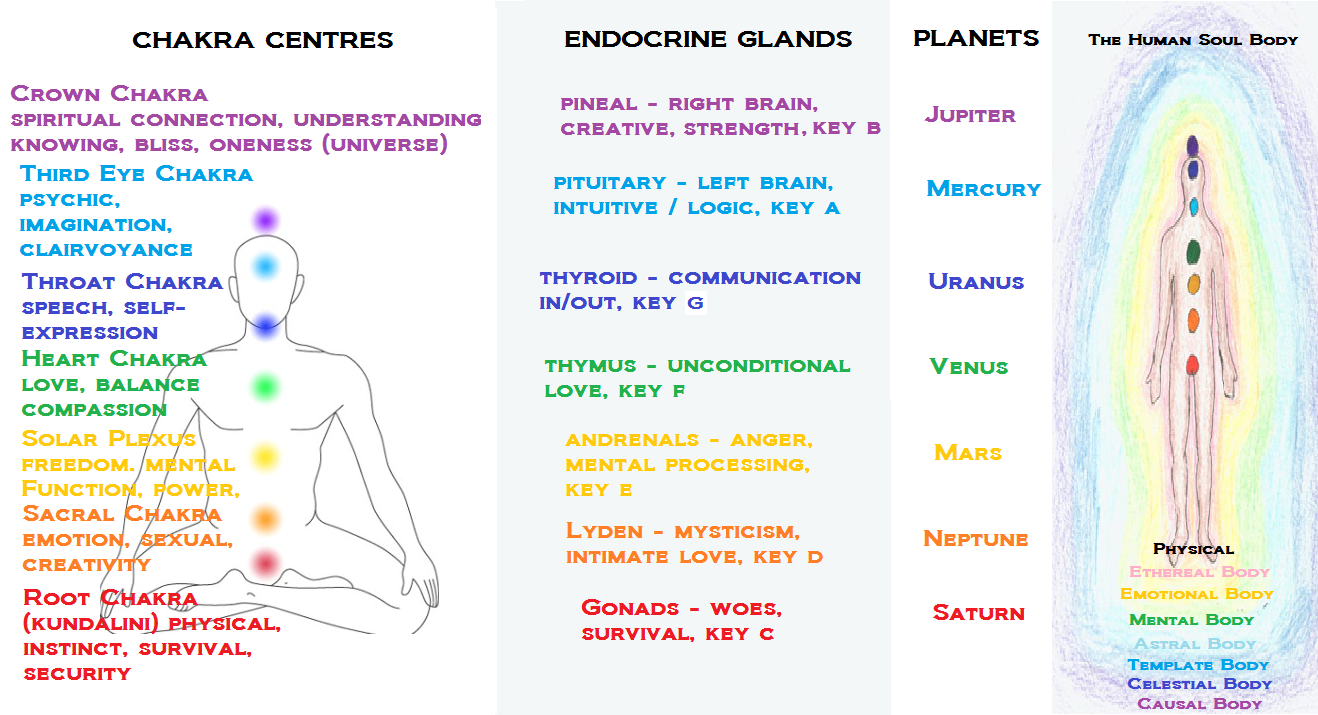
 Chakras are the energy centers in our body. The word “chakra” means “wheel”. We have seven main chakras and each chakra is located on a plexus (center of a network of nerves). These energy centers are responsible for keeping our spiritual, physical and mental aspects in balance. This subtle system is the same in every human. What is different is how we use it and with what quality.

